My friend Anna has been doing some amazing things in the Renewable Energy space. She just organized this Kerry fundraiser here in San Francisco which I am posting here. Email me if you want more info. Its a minimum of $100 a person:
Greetings,
I am emailing to invite you to a CleanTech fundraiser for John Kerry on
April 28th. Hosted at the Fairmont in conjunction with the CleanTech
Venture Forum, its a great opportunity to come meet some wonderful Bay Area
investors, entrepreneurs, and technologists in the renewable energy and
clean technology space AND help John Kerry win back the White House!
Hosted by Andrew Beebe, CEO - Energy Innovations, Greg Gretsch, Managing
Director - Sigma Partners, Randall Hayes, Rainforest Action, Peter Liu,
Principal - LM Investment, Thomas Layton, Eric Macris, Sunil Paul, Founder
of Brightmail and Angel Investor, Barney Pell, Martin Roscheisen, CEO - Nano
Solar, Joel Serface, Venture Manager - Eastman Ventures, Sanjay Wagle,
Principal - Expansion Capital Partners, and me!
More details to follow.
Best regards and many thanks,
Anna
Thursday, April 15, 2004
"Take a twenty-four hour trip through the mind of Beethoven. Join us for a once-in-a-lifetime all-night pajamas-please sleep-over concert-event at 964 Natoma."
Friday, April 09, 2004
Did the ancients think that the stars were campfires burning in the sky?
Lately it is as if i were traversing a large dark field speckled with campfires. Each fire holds a small group of people who invite me to drink hot tea, to warm my body and listen to their stories. I introduce myself and listen closely. This metaphor has strength for me.
I remember walking on dark beaches in San Diego, beaches illuminated only by a string of campfires. Walking by the cold tides, our bare feet bouncing on the wet sand, we would walk from one to the next. As we approached each one, what seemed like dark stirrings took on a human face. A small band of people would emerge, mumblings became words, became conversations and each fire became an island. As we walked away, the warm chatter would again get washed out by the sounds of the ocean and we'd be again stumbling in the darkness, guiding ourselves by the light of the approaching flames.
The path is dark and uncertain and so it is natural that we create communities to huddle with, to exchange dreams.
The other day I lay in Dolores park with M. and her roommate, our bellies exposed to the sun. The day was warm and so we were surrounded by couples and groups on their blankets. I shared stories of things I had recently heard and seen. M. laughed as we agreed that you do not need to visit foreign cities to get a taste of the culturally strange.
Lately it is as if i were traversing a large dark field speckled with campfires. Each fire holds a small group of people who invite me to drink hot tea, to warm my body and listen to their stories. I introduce myself and listen closely. This metaphor has strength for me.
I remember walking on dark beaches in San Diego, beaches illuminated only by a string of campfires. Walking by the cold tides, our bare feet bouncing on the wet sand, we would walk from one to the next. As we approached each one, what seemed like dark stirrings took on a human face. A small band of people would emerge, mumblings became words, became conversations and each fire became an island. As we walked away, the warm chatter would again get washed out by the sounds of the ocean and we'd be again stumbling in the darkness, guiding ourselves by the light of the approaching flames.
The path is dark and uncertain and so it is natural that we create communities to huddle with, to exchange dreams.
The other day I lay in Dolores park with M. and her roommate, our bellies exposed to the sun. The day was warm and so we were surrounded by couples and groups on their blankets. I shared stories of things I had recently heard and seen. M. laughed as we agreed that you do not need to visit foreign cities to get a taste of the culturally strange.
Sunday, April 04, 2004
From there, after six days and seven nights, you arrive at Zobeide, the white city, well exposed to the moon, with streets wound about themselves as in a skein. They tell this tale of its foundation: men of various nations had an identical dream. They saw a woman running at night through an unknown city; she was seen from behind, with long hair, and she was naked. They dreamed of pursuing her. As they twisted and turned, each of them lost her. After the dream, they set out in search of that city; they never found it, but they found one another; they decided to build a city like the one in the dream. In laying out the streets, each followed the course of his pursuit; at the spot where they had lost the fugitive's trail, they arranged spaces and walls differently from the dream, so she would be unable to escape again.
This was the city of Zobeide, where they settled, waiting for that scene to be repeated one night. None of them, asleep or awake, ever saw the woman again. The city's streets were streets where they went to work every day, with no link any more to the dreamed chase. Which, for that matter, had long been forgotten.
New men arrived from other lands, having had a dream like theirs, and in the city of Zobeide, they recognized something from the streets of the dream, and they changed the positions of arcades and stairways to resemble more closely the path of the pursued woman and so, at the spot where she had vanished, there would remain no avenue of escape.
The first to arrive could not understand what drew these people to Zobeide, this ugly city, this trap.
Cities and Desires (Calvino)
This was the city of Zobeide, where they settled, waiting for that scene to be repeated one night. None of them, asleep or awake, ever saw the woman again. The city's streets were streets where they went to work every day, with no link any more to the dreamed chase. Which, for that matter, had long been forgotten.
New men arrived from other lands, having had a dream like theirs, and in the city of Zobeide, they recognized something from the streets of the dream, and they changed the positions of arcades and stairways to resemble more closely the path of the pursued woman and so, at the spot where she had vanished, there would remain no avenue of escape.
The first to arrive could not understand what drew these people to Zobeide, this ugly city, this trap.
Cities and Desires (Calvino)


Maps from Tangential University via invertebra
I was trying to describe to someone the level of graffiti I saw when I was in East Berlin. I looked around and stumbled upon this great site Urban Haute Couture which collects photos of street art from Berlin and Amsterdam and Hamburg. Their Bucharest section also includes stencils which can be found at the Romanian Stencil Archive.
Two literary puzzles I haven't been able to solve:
1. In Nabokov's "Speak, Memory" he writes "We subjected [Uncle Ruka] to a test one day, and in a twinkle he turned the sequence '5.13 24.11 13.16 9.13.5 5.13 24.11' into the opening words of a famous monologue in Shakespeare." The monologue is 'To be or not to be' from Hamlet but the question is whether this was an arbitrary substitution cipher.
Oddly, the first few letters follow the pattern of a rotational cypher where the next letter is x fixed places from the previous (e.g. O(13)=T-5. B(24)=O+13.) but that pattern collapses quickly. It may just be random but I cant get it out of my mind.
2. Borges, in his short-story The Rose of Paracelsus introduces the name Johannes Grisebach out of nowhere! Who is Grisebach? There was an Eduard Grisebach, a poet and the editor of the works of Schopenhauer who was known to Borges.
1. In Nabokov's "Speak, Memory" he writes "We subjected [Uncle Ruka] to a test one day, and in a twinkle he turned the sequence '5.13 24.11 13.16 9.13.5 5.13 24.11' into the opening words of a famous monologue in Shakespeare." The monologue is 'To be or not to be' from Hamlet but the question is whether this was an arbitrary substitution cipher.
Oddly, the first few letters follow the pattern of a rotational cypher where the next letter is x fixed places from the previous (e.g. O(13)=T-5. B(24)=O+13.) but that pattern collapses quickly. It may just be random but I cant get it out of my mind.
2. Borges, in his short-story The Rose of Paracelsus introduces the name Johannes Grisebach out of nowhere! Who is Grisebach? There was an Eduard Grisebach, a poet and the editor of the works of Schopenhauer who was known to Borges.
Sunday, March 14, 2004
I liked so much the way she would suddenly sit down on a wall, or a broken pillar in that shattered backyard to Pompey's pillar, and be plunged in an inextinguishable sorrow at some idea whose impact had only just made itself felt in her mind.
"You really believe so?" she would say with such sorrow that one was touched and amused at the same time. "And why do you smile? You always smile at the most serious things. Ah! surely you should be sad?" If she ever knew me at all she must later have discovered that for those of us who feel deeply and who are at all conscious of the inextricable tangle of human thought there is only one response to be made - ironic tenderness and silence.
In a night so brilliant with stars where the glow-worms in the shrill dry grass gave back their ghostly mauve lambence to the sky there was nothing else to do but sit by her side, stroking that dark head of beautiful hair and saying nothing.
Underneath, like a dark river, the noble quotation which Balthazar had taken as text and which he read in a voice which trembled with emotion and partly with the fatigue of so much abstract thought: "The day of the corpora is the night for the spiritus. When the bodies cease their labour the spirits in man begin their work. The waking of the body is the sleep of the spirit and the spirit's sleep a waking for the body"
-From Durrell's Justine
"You really believe so?" she would say with such sorrow that one was touched and amused at the same time. "And why do you smile? You always smile at the most serious things. Ah! surely you should be sad?" If she ever knew me at all she must later have discovered that for those of us who feel deeply and who are at all conscious of the inextricable tangle of human thought there is only one response to be made - ironic tenderness and silence.
In a night so brilliant with stars where the glow-worms in the shrill dry grass gave back their ghostly mauve lambence to the sky there was nothing else to do but sit by her side, stroking that dark head of beautiful hair and saying nothing.
Underneath, like a dark river, the noble quotation which Balthazar had taken as text and which he read in a voice which trembled with emotion and partly with the fatigue of so much abstract thought: "The day of the corpora is the night for the spiritus. When the bodies cease their labour the spirits in man begin their work. The waking of the body is the sleep of the spirit and the spirit's sleep a waking for the body"
-From Durrell's Justine
Wednesday, March 10, 2004
I like the energy that Florian captures in his photos. Flo is a friend of Mina's who stayed with her last week.
The week before that was Mina's 29th Birthday!! Happy belated birthday Mina. You only seem to grow younger like you've built your own secret time machine.
What I like about Mina's own photographs are their sense of assurance. She has an accomplished eye. I don't know why I like these two harbor pictures so much, but I do.
On the subject of birthdays, my friend Paul is celebrating his birthday this week in Paris. By some strange conjunction of events, the kind of stuff usually associated with planetary alignments, it looks like I might be in Paris in a few days to join him. This is good. I'd like to finally meet his friend Jenn (below with paul), who was a news anchor for Hong Kong TV, as well as Paul's sister Elizabeth, who is in the world of Paris couture, and whom I have always admired from afar.

The week before that was Mina's 29th Birthday!! Happy belated birthday Mina. You only seem to grow younger like you've built your own secret time machine.
What I like about Mina's own photographs are their sense of assurance. She has an accomplished eye. I don't know why I like these two harbor pictures so much, but I do.
On the subject of birthdays, my friend Paul is celebrating his birthday this week in Paris. By some strange conjunction of events, the kind of stuff usually associated with planetary alignments, it looks like I might be in Paris in a few days to join him. This is good. I'd like to finally meet his friend Jenn (below with paul), who was a news anchor for Hong Kong TV, as well as Paul's sister Elizabeth, who is in the world of Paris couture, and whom I have always admired from afar.
Monday, March 08, 2004
The Latin Jungle
La Selva Latinoamericana
In Venezuela it was the writer Romulo Gallegos who in 1929 penned perhaps one of the first indigenous novels, Dona Barbara. Here, the natural world arises as a powerful protagonist. The Latin American novel seems to first take form as a drama in which the European man is soaked in the wild, savage psychology of the native world.
A better novel still is Gallegos' Canaima in which the landscape itself defines the course of the novel. Canaima is about one man's futile struggle against the forces of nature, and by implication - destiny. I wanted to quote from Canaima but after looking around for days, even through old boxes of books, I am giving up. The climactic chapter has the protagonist caught in the jungle far from home as a violent storm approaches. He decides to tear his clothes off to confront the storm head on, hugs the largest nearby tree and confronts the elements - wind, rain, lightning, earth - one by one as a series of heroic trials.
Miguel Angel Asturias Men of Maize, however, was the first to combine the European form with the magical, dream-like narratives of native folktales to create what is known today as 'magical realism' (Asturias even won the Nobel prize and yet is still fairly unknown) Men of Maize is so deeply imbedded in Native culture it is an adaptation of the Maya's Popol Vuh. It is difficult to read if you do not know what it references. But it is beautiful, hallucinatory writing with the rhythm and unexpectedness of a large prose poem. A sample:
The word of the earth turned to flame by the sun almost set fire to the maize-leaf ears of the yellow rabbits...but Gaspar was once again becoming earth that falls from where the earth falls, which is to say, sleep that finds no shade in which to dream in the soil of Ilom, and the solar flame of the voice could do nothing, tricked by the yellow rabbits that set to suckling in a papaya grove, turned into forest papayas, that planted themselves in the sky, turned to stars, and faded into the water like reflections with ears.
Asturias' contemporary is the much more readable Alejo Carpentier. His book The Lost Steps is in many ways a very modern piece of fiction which reads like an adventure story. An ethno-musicologist from New York City flees into the jungle in search of ancient music. But the jungle, of course, not only transforms him but also twists the storyline, imposing its own ancient sense of time and narrative as the protagonist wanders farther and farther away from his modern reality. The Lost steps is one of those books which I at first read quickly, only to realize later how much I had missed.
The last pearl in this string is Alvaro Mutis' The Adventures and Misadventures of Maqroll. Garcia Marquez admires Mutis fiercely. Mutis is Joseph Conrad mixed with Garcia Marquez yet, like any original writer, comparisons are unfair. Maqroll is the individual, the thinking man who, forged from the jungle, can now embody it and make it his own. Maqroll is a fearless voyager, a philosopher with odd observations and aphorisms, an observer unbound by his environment. He has no home but the world is his home. Mutis' writing is so immediate, so real, that I want to re-read it even as I am reading it.
A caravan doesnt symbolize or represent anything. Our mistake is to think that its going somewhere, leaving somewhere. The caravan exhausts its meaning by merely moving from place to place. The animals in the caravan know this, but the camel drivers don't. It will always be this way.
And,
A woman's body under the rush of a mountain waterfall, her brief cries of surprise and joy, the movement of her limbs in the rapid foam that carries red coffee berries, sugarcane pulp, insects struggling to escape the current: this is the exemplary happiness that surely never comes again.
Both from Mutis' The Snow of the Admiral
La Selva Latinoamericana
In Venezuela it was the writer Romulo Gallegos who in 1929 penned perhaps one of the first indigenous novels, Dona Barbara. Here, the natural world arises as a powerful protagonist. The Latin American novel seems to first take form as a drama in which the European man is soaked in the wild, savage psychology of the native world.
A better novel still is Gallegos' Canaima in which the landscape itself defines the course of the novel. Canaima is about one man's futile struggle against the forces of nature, and by implication - destiny. I wanted to quote from Canaima but after looking around for days, even through old boxes of books, I am giving up. The climactic chapter has the protagonist caught in the jungle far from home as a violent storm approaches. He decides to tear his clothes off to confront the storm head on, hugs the largest nearby tree and confronts the elements - wind, rain, lightning, earth - one by one as a series of heroic trials.
Miguel Angel Asturias Men of Maize, however, was the first to combine the European form with the magical, dream-like narratives of native folktales to create what is known today as 'magical realism' (Asturias even won the Nobel prize and yet is still fairly unknown) Men of Maize is so deeply imbedded in Native culture it is an adaptation of the Maya's Popol Vuh. It is difficult to read if you do not know what it references. But it is beautiful, hallucinatory writing with the rhythm and unexpectedness of a large prose poem. A sample:
The word of the earth turned to flame by the sun almost set fire to the maize-leaf ears of the yellow rabbits...but Gaspar was once again becoming earth that falls from where the earth falls, which is to say, sleep that finds no shade in which to dream in the soil of Ilom, and the solar flame of the voice could do nothing, tricked by the yellow rabbits that set to suckling in a papaya grove, turned into forest papayas, that planted themselves in the sky, turned to stars, and faded into the water like reflections with ears.
Asturias' contemporary is the much more readable Alejo Carpentier. His book The Lost Steps is in many ways a very modern piece of fiction which reads like an adventure story. An ethno-musicologist from New York City flees into the jungle in search of ancient music. But the jungle, of course, not only transforms him but also twists the storyline, imposing its own ancient sense of time and narrative as the protagonist wanders farther and farther away from his modern reality. The Lost steps is one of those books which I at first read quickly, only to realize later how much I had missed.
The last pearl in this string is Alvaro Mutis' The Adventures and Misadventures of Maqroll. Garcia Marquez admires Mutis fiercely. Mutis is Joseph Conrad mixed with Garcia Marquez yet, like any original writer, comparisons are unfair. Maqroll is the individual, the thinking man who, forged from the jungle, can now embody it and make it his own. Maqroll is a fearless voyager, a philosopher with odd observations and aphorisms, an observer unbound by his environment. He has no home but the world is his home. Mutis' writing is so immediate, so real, that I want to re-read it even as I am reading it.
A caravan doesnt symbolize or represent anything. Our mistake is to think that its going somewhere, leaving somewhere. The caravan exhausts its meaning by merely moving from place to place. The animals in the caravan know this, but the camel drivers don't. It will always be this way.
And,
A woman's body under the rush of a mountain waterfall, her brief cries of surprise and joy, the movement of her limbs in the rapid foam that carries red coffee berries, sugarcane pulp, insects struggling to escape the current: this is the exemplary happiness that surely never comes again.
Both from Mutis' The Snow of the Admiral
Sunday, March 07, 2004
I.
Simultaneously, moments in life are disconnnected episodes and also part of a larger narrative. In the first case, moments of peace and sleep are dividers which separate self-contained events, oases of experience which are presented to us much as a cinematic moment. In the latter case, experience is an elaborate but not incongruos story which unwinds erratically, as if told by a stuttering and distracted storyteller.
II.
We all have the hands of a sculptor. Events unfold that have that sense of both accident and providence, like a meteoric collision. We catch them and shape them into something we can understand, coloring them with our own private set of pigments.
III.
This morning the sun was too bright and so I squinted like a beast who had emerged from a cave, holding my black coffee with both hands as if it were a precious stone.
Simultaneously, moments in life are disconnnected episodes and also part of a larger narrative. In the first case, moments of peace and sleep are dividers which separate self-contained events, oases of experience which are presented to us much as a cinematic moment. In the latter case, experience is an elaborate but not incongruos story which unwinds erratically, as if told by a stuttering and distracted storyteller.
II.
We all have the hands of a sculptor. Events unfold that have that sense of both accident and providence, like a meteoric collision. We catch them and shape them into something we can understand, coloring them with our own private set of pigments.
III.
This morning the sun was too bright and so I squinted like a beast who had emerged from a cave, holding my black coffee with both hands as if it were a precious stone.
Tuesday, March 02, 2004

This will be a reminder to myself to attend the Isabel Samaras shows later this month here in San Francisco. The pop-culture-meets-Art thing is difficult to pull off well.
My friend Thomas in college believed strongly in the circular theory of Aesthetics. That is, if something is terrible it has the potential to be magnificently terrible. Anybody can create art that is uninspired but to able to create something truly monstrous takes talent and inspiration. And so the truly bad is also the truly great.
He used to search for music and art that was so bad it was sublime. He'd play old homegrown records he dug up in garage sales, home-recorded stuff say of someone singing in the high-pitched voice of a child, strange symphonies that sounded like a huge catfight, all in search of that magnificently terrible.
I still think of Thomas when I see a lot of pop art these days. I like the work of Samaras because she doesn't take herself too seriously. She can unite Botticelli's Venus and Gilligan's Island in a way that is both funny and new. She's also done a lot of illustrations and the one above is one she did for Bitch magazine.

A while back I posted about the New Yorker covers done by Eric Drooker. The cover above is another one by him titled X-Ray Manhattan. That cover and many others will be showing here in San Francisco starting this week. There's a special opening for the show this Thursday which I have an invitation for and I'd like to attend but I probably won't be able to.
Saturday, February 28, 2004
If any of the files on the playlist have ever intrigued you, now is the time to pull them down. That server will be disappearing in a few days and it is doubtful that I will rebuild it somewhere else.
Tuesday, February 17, 2004
The cat Dinofelis, known as a false saber-tooth, was a specialized hunter of hominids. It seems to have enjoyed eating baboons and most likely, early humans.
The paleontologist C.K. Brain, in his book Hunter or the Hunted?, suggests that early man was more often prey than predators. Our move to predator status was a modern thing. We constructed fire and weapons and reversed an old power structure.
The writer Bruce Chatwin, a fascinating figure of his own, was drawn to Brain's theories. For Chatwin, Brain had discovered the ultimate fabled beast that lurks in our imaginations. Nicholas Shakespeare, in his biography of Chatwin, writes:
For two days Bruce engaged Brain in conversations which he described as "the most stimulating discussions in my life"... If the leopard-like cat had preyed on our ancestors, then man in his origins was not necessarily aggressive. He lived his life in fear, dinofelis watching him from the shadows.
Bruce--who called the cat "the Prince of Darkness"--amused the older man. Brain says, "He understood 'the Prince of Darkness' as a psychological necessity. He thought we had lived so long with prowling nocturnal predators they had become part of our make-up. When we no longer had these animals in bodily form, we invented dragons and heroes who went off to fight them." Discussing, for instance, Uccello's painting of St. George in the act of lancing the dragon, Bruce seemed to think this was an illustration of what had actually happened.
Brain had misgivings about this nostalgia for "the Beast we have lost". Nevertheless, it excited him to watch Bruce take his work and run with it. "Chatwin was like a nineteenth-century synthesiser," says Brain. "There is a place again for that kind of generalist, someone who can wander among specialised fields and pull things together. Otherwise it's very compartmentalised and syntheses don't really occur." The two men talked late into the night and on the following day they drove to the cave at Swartkrans.
Swartkrans is where Brain discovered the earliest use of fire by man. It is thus, in Brain's account, the epic place where the battle was turned.
The paleontologist C.K. Brain, in his book Hunter or the Hunted?, suggests that early man was more often prey than predators. Our move to predator status was a modern thing. We constructed fire and weapons and reversed an old power structure.
The writer Bruce Chatwin, a fascinating figure of his own, was drawn to Brain's theories. For Chatwin, Brain had discovered the ultimate fabled beast that lurks in our imaginations. Nicholas Shakespeare, in his biography of Chatwin, writes:
For two days Bruce engaged Brain in conversations which he described as "the most stimulating discussions in my life"... If the leopard-like cat had preyed on our ancestors, then man in his origins was not necessarily aggressive. He lived his life in fear, dinofelis watching him from the shadows.
Bruce--who called the cat "the Prince of Darkness"--amused the older man. Brain says, "He understood 'the Prince of Darkness' as a psychological necessity. He thought we had lived so long with prowling nocturnal predators they had become part of our make-up. When we no longer had these animals in bodily form, we invented dragons and heroes who went off to fight them." Discussing, for instance, Uccello's painting of St. George in the act of lancing the dragon, Bruce seemed to think this was an illustration of what had actually happened.
Brain had misgivings about this nostalgia for "the Beast we have lost". Nevertheless, it excited him to watch Bruce take his work and run with it. "Chatwin was like a nineteenth-century synthesiser," says Brain. "There is a place again for that kind of generalist, someone who can wander among specialised fields and pull things together. Otherwise it's very compartmentalised and syntheses don't really occur." The two men talked late into the night and on the following day they drove to the cave at Swartkrans.
Swartkrans is where Brain discovered the earliest use of fire by man. It is thus, in Brain's account, the epic place where the battle was turned.
Sunday, February 08, 2004
The Mayan calendar is based on the idea of cycles and cycles within cycles. This is not too different than either the Ptolemaic system or even the modern view of a moon that revolves around a planet that revolves around a Sun that in turn revolves around the center of a galaxy.
At some point though we discard the notion of cycles when it comes to human progress. Although we like to play with ideas of a post-nuclear world where civilization must rebuild itself, the prevailing view is that progress is linear, that life and civilization will expand and grow until it dominates not only other solar systems but also the entire universe.
This attitude is embodied in such theories as Frank Tipler's idea of an Omega point or among the futuristic theories of Nick Bostrom and his fellow transhumanists. The essential idea is that the future is limitless and that scientific progress, now that it has fully developed its young wings and survived the peril of being quashed by other dogmas, is poised for flight.
Once you accept the idea that we will continue to grow and develop until we are well past the point of being superhuman you can make all sorts of deductions. Tipler's Omega point theory relies on the idea that we will be able to control the universe and harness its seemingly limitless computing power. What will we do with all this power? Why we will of course use it to reconstruct simulations of our own past! Including, of course, this past, the world we live in now, inhabited by you and me and all of our loved ones and even our not so-loved ones. Also, hopefully, our pets. This is our immortality. We will be brought back to life, reconstituted by our super-powerful descendants, like a can of dried milk.
As outrageous as that may seem, Bostrom goes even further. He argues essentially that our descendants will not just construct one simulation, but countless numbers of them. After all, they live in an infinite future, harnessing the power of universes. Why shouldn't they build not just one Napoleonic War but also re-run it endlessly, as we re-run films, creating us in each viewing.
The outrageous and inevitable conclusion is this: If there are so many simulations and only one authentic version, well, what really are the chances that we are that authentic version? Bostrom argues that it is much more likely that we are a copy, that we are a mere simulation, and so he urges us to accept that.
The Mayans, as I was saying earlier, held, in contrast, that it is cycles all the way up. The universe will end. We will end. Everything will begin again. This may even happen as soon as 2012.
At this point it is not clear to me which view of the world makes more sense.
At some point though we discard the notion of cycles when it comes to human progress. Although we like to play with ideas of a post-nuclear world where civilization must rebuild itself, the prevailing view is that progress is linear, that life and civilization will expand and grow until it dominates not only other solar systems but also the entire universe.
This attitude is embodied in such theories as Frank Tipler's idea of an Omega point or among the futuristic theories of Nick Bostrom and his fellow transhumanists. The essential idea is that the future is limitless and that scientific progress, now that it has fully developed its young wings and survived the peril of being quashed by other dogmas, is poised for flight.
Once you accept the idea that we will continue to grow and develop until we are well past the point of being superhuman you can make all sorts of deductions. Tipler's Omega point theory relies on the idea that we will be able to control the universe and harness its seemingly limitless computing power. What will we do with all this power? Why we will of course use it to reconstruct simulations of our own past! Including, of course, this past, the world we live in now, inhabited by you and me and all of our loved ones and even our not so-loved ones. Also, hopefully, our pets. This is our immortality. We will be brought back to life, reconstituted by our super-powerful descendants, like a can of dried milk.
As outrageous as that may seem, Bostrom goes even further. He argues essentially that our descendants will not just construct one simulation, but countless numbers of them. After all, they live in an infinite future, harnessing the power of universes. Why shouldn't they build not just one Napoleonic War but also re-run it endlessly, as we re-run films, creating us in each viewing.
The outrageous and inevitable conclusion is this: If there are so many simulations and only one authentic version, well, what really are the chances that we are that authentic version? Bostrom argues that it is much more likely that we are a copy, that we are a mere simulation, and so he urges us to accept that.
The Mayans, as I was saying earlier, held, in contrast, that it is cycles all the way up. The universe will end. We will end. Everything will begin again. This may even happen as soon as 2012.
At this point it is not clear to me which view of the world makes more sense.
I am ashamed to admit I was at the orkut.com launch party on friday night at Suite 181. Hey! the alcohol was free and suite 181 is a very cool space but the night was indeed Revenge of the Nerds.
Case in point: Even though the drinks were free, I tipped the bartenders with each drink. Nobody else was doing this. These were, after all, the regular bartenders.
I also came out of it with several Orkut pens which glow in three different colors. Ebay material.
Case in point: Even though the drinks were free, I tipped the bartenders with each drink. Nobody else was doing this. These were, after all, the regular bartenders.
I also came out of it with several Orkut pens which glow in three different colors. Ebay material.
Saturday, February 07, 2004
An early interest in Eastern spirituality and Zen mysticism in particular led me to read the books of Janwillem Van de Wetering. His book, The Empty Mirror, describes the experiences of a Westerner (a dutchman) studying at a Japanese Zen monastery.
I didnt realize until recently that Van de Wetering was now a popular and well-known mystery writer. I am currently reading through all his books. There is without a doubt an aura of religious detachment, of serenity, that permeates these novels and makes them also incredibly absorbing and readable. Here, for example, is an exchange from two detectives from the book, The Perfidious Parrot:
"No, seriously, sir. Even if the Amabagts arranged for that bunk inspector to drive into our dinner, the crime would not affect our project. Why bother with Quadrant? The goal recedes while we lose our way."
"You can't lose a way you're on," the commisaris said. "Besides the road is the goal. Make that call will you?"
I didnt realize until recently that Van de Wetering was now a popular and well-known mystery writer. I am currently reading through all his books. There is without a doubt an aura of religious detachment, of serenity, that permeates these novels and makes them also incredibly absorbing and readable. Here, for example, is an exchange from two detectives from the book, The Perfidious Parrot:
"No, seriously, sir. Even if the Amabagts arranged for that bunk inspector to drive into our dinner, the crime would not affect our project. Why bother with Quadrant? The goal recedes while we lose our way."
"You can't lose a way you're on," the commisaris said. "Besides the road is the goal. Make that call will you?"
Friday, January 30, 2004

MiniBosses is a cover band that covers themes from Super Nintendo (SNES) games. At first I thought this was some kind of post-ironic thing but the bandmembers seem fun and dedicated to their videogames. A lot of kids grew up on this music. I am not so familiar with many of the tunes but I am a fan of the often strange mix of the cartoony and the operatic. Here's some strange, sometimes beautiful rock instrumentals from MiniBosses:
Kraid Metroid
MegaMan 2
Ghosts 'n Goblins
Wizards and Warriors
Talking about post-ironic I had a strange Frank Chu sighting. It wasn't his sign about the Zegatronic Rocket Society or the latest news about the 12 Galaxies that was strange. I'm used to that, as is anyone who has been through San Francisco's Financial District.
This time though he was at 111 Minna, a nightclub here in San Francisco. Some friends and I were there this past wednesday because DJ Spesh was doing his first all-night set. Anyways, Frank Chu was there along with his sign, standing back a little from the crowd.
Now, Frank Chu has become a lovable figure here in the city. He is always there with his indecipherable signs walking determinedly up and down the street. I'm a little distressed though that he is now hanging out at nightclubs (though I suspect someone coaxed him in) since it polishes away some of his outsider status.
Its always disappointing to see the quirky and authentic dissolve as a crowd of people grasp at it, not unlike how old monuments vanish piece by piece inside the pockets of tourists.
(still, frank chu may not be so easily captured. He seems to show up at the strangest places (warning: nudity))
Monday, January 26, 2004
Wow, what happened to january? I never meant to ignore this little pet project of mine.
This month has been drab and sunless here in san francisco. There's something vacant in the air, like someone has just left. An absence.
As I was falling asleep a couple nights ago I thought I heard a door open and close, as if someone had walked into the house. I thought about checking but I was already drifting into dreams and it is not uncommon to hear stray noises from the street. A. had just left the day before and so I was alone in the house.
Later that night, my sleep was disturbed when I felt something like a human hand brushing my forehead. The room, I remember, was unusually warm and I was sweating. I opened my eyes and turned my body to look around. When I looked up I saw someone standing next to my bed. It was still dark and I couldnt make out much more than a silhouette. The figure had come in through my bedroom door which was half-open and I could see that the hallway light seemed to be on.
My first instinct was not fear but more like anger. I was angry at myself that I had let this happen. I yelled out 'Get out of here! Get out!' but my screams were half-choked. I felt as if I were gargling rather than screaming. I don't know whether I was dreaming or I had just fallen back into a dream. The room seemed real enough except for the presence of this figure who was now dissapearing. I fell back into sleep.
When I woke up a little later, I looked around and noticed only that my bedside clock had been turned upside-down. Did I do that myself in the middle of the night? My bedroom door was closed. I got out of bed and went around the house checking that all the doors were locked. They were.
It was still dark out. I stayed up in the kitchen until I saw daylight. Only then did I go back to bed to get some more sleep.
This month has been drab and sunless here in san francisco. There's something vacant in the air, like someone has just left. An absence.
As I was falling asleep a couple nights ago I thought I heard a door open and close, as if someone had walked into the house. I thought about checking but I was already drifting into dreams and it is not uncommon to hear stray noises from the street. A. had just left the day before and so I was alone in the house.
Later that night, my sleep was disturbed when I felt something like a human hand brushing my forehead. The room, I remember, was unusually warm and I was sweating. I opened my eyes and turned my body to look around. When I looked up I saw someone standing next to my bed. It was still dark and I couldnt make out much more than a silhouette. The figure had come in through my bedroom door which was half-open and I could see that the hallway light seemed to be on.
My first instinct was not fear but more like anger. I was angry at myself that I had let this happen. I yelled out 'Get out of here! Get out!' but my screams were half-choked. I felt as if I were gargling rather than screaming. I don't know whether I was dreaming or I had just fallen back into a dream. The room seemed real enough except for the presence of this figure who was now dissapearing. I fell back into sleep.
When I woke up a little later, I looked around and noticed only that my bedside clock had been turned upside-down. Did I do that myself in the middle of the night? My bedroom door was closed. I got out of bed and went around the house checking that all the doors were locked. They were.
It was still dark out. I stayed up in the kitchen until I saw daylight. Only then did I go back to bed to get some more sleep.
Tuesday, January 06, 2004

What a gorgeous trailer! i haven't been able to track down the background music in the trailer but it seems like it might be from a band named Die Knodel.
I am so proud. I feel like an uncle.
Ian was my roommate at Harvard. I looked up to him because he was one of those magical people who just breezed through any task. He was the editor of Let's Go Spain and a talented writer. Alhough he was an East-Asian studies major (he had to learn japanese for this) he decided to take an advanced algebra course just for the fun of it. He aced it of course.
After graduation, he got a scholarship to go travel in Asia. It is as if a bird had been released. He traveled all over Asia - China, Thailand, Southeast Asia - and stayed in Asia even after his grant money ran out. He would send occassinal missives to me and to other friends documenting his journey and his continued efforts to find new creative ways to survive.
He wrote it all down for us furiously. There was a famous "letter" that Matt, another friend of his, received. It was actually a roll of toilet paper that had to be unwound to be read. The writing was crooked and nearly illegible, like a mad scrawl. Ian had written it in a bathroom where, he wrote, he had had to spend the night having no other place to stay. He was living close to life's ground level, holing up in squalid areas, getting involved in strange affairs. His letters were full of his adventures - families who took him in, girlfriends who attached themselves to him and supported him, short stints doing busywork for foreign companies in order to fend off starvation.
Later, traveling through India, he wrote us of meeting yet another girl - another in the endless parade, or so we thought. Her name was Jessica and she was bicycling through India by herself. They joined together for a while, partners in wanderlust, and traveled the southasian countryside together. They made a brief visit to New York then, I remember, and we, his friends, dismissed her as the woman of the month. We couldnt have been more wrong. Ten years later, they have never left each other's side.
They lived in India together. Later they decided to move to Tokyo together, where they each took jobs which were unchallenging but were also keys to a life in Japan, their lives filling up with more stories, of strange fights with their neighbors, of making a life for themselves in a land unwelcoming to foreigners, of social encounters and misunderstandings that bordered on the surreal.
They lived also in Europe. They took the Siberian railway and lived in Prague. Also Italy and then in Austria. Over the years I would lose track of these two nomads until a letter would suddenly arrive in my mailbox bearing strange postal stamps and warm regards. They always found me.
After being together for almost ten years, they decided a couple years ago to get married. The wedding was held on the country estate of Jessica's parents - just outside of London. I flew from san francisco to attend. Friends of theirs from all over the world were there. I stayed in a little country Inn with a couple from Tunisia.
I still tell people that this is the best wedding I have ever been to. The wedding was in a small old medieval church. This was a full british wedding with the men in top hats and the women wearing long gloves. It was a small spectacle. Each of the reception tables was named after a country that Ian and Jessica had lived in. Ian's family composed and sang a capella (his family is full of wonderful singers) a piece they had put together for the affair. We stayed up all night, drinking, teaching each other new dances, telling intimate stories.
As the dawn broke, the entire wedding party walked across the countryside, crossing farmlands single-file behind the bride and groom like one of those animated promenades from a fellini movie. We arrived at a small pub that had been expecting us all for breakfast. Many of us continued to drink and toast. The bride and groom announced that for their honeymoon they were headed off an another adventure - they were heading to Bangladesh.
I just saw them a few months ago on my way back from Germany and stayed at their house in London. I have never seen them so domestic, arguing about the plumbers bill or about what plants belonged in the garden.
It was only recently that Jessica told me that a child was on the way.
Ian was my roommate at Harvard. I looked up to him because he was one of those magical people who just breezed through any task. He was the editor of Let's Go Spain and a talented writer. Alhough he was an East-Asian studies major (he had to learn japanese for this) he decided to take an advanced algebra course just for the fun of it. He aced it of course.
After graduation, he got a scholarship to go travel in Asia. It is as if a bird had been released. He traveled all over Asia - China, Thailand, Southeast Asia - and stayed in Asia even after his grant money ran out. He would send occassinal missives to me and to other friends documenting his journey and his continued efforts to find new creative ways to survive.
He wrote it all down for us furiously. There was a famous "letter" that Matt, another friend of his, received. It was actually a roll of toilet paper that had to be unwound to be read. The writing was crooked and nearly illegible, like a mad scrawl. Ian had written it in a bathroom where, he wrote, he had had to spend the night having no other place to stay. He was living close to life's ground level, holing up in squalid areas, getting involved in strange affairs. His letters were full of his adventures - families who took him in, girlfriends who attached themselves to him and supported him, short stints doing busywork for foreign companies in order to fend off starvation.
Later, traveling through India, he wrote us of meeting yet another girl - another in the endless parade, or so we thought. Her name was Jessica and she was bicycling through India by herself. They joined together for a while, partners in wanderlust, and traveled the southasian countryside together. They made a brief visit to New York then, I remember, and we, his friends, dismissed her as the woman of the month. We couldnt have been more wrong. Ten years later, they have never left each other's side.
They lived in India together. Later they decided to move to Tokyo together, where they each took jobs which were unchallenging but were also keys to a life in Japan, their lives filling up with more stories, of strange fights with their neighbors, of making a life for themselves in a land unwelcoming to foreigners, of social encounters and misunderstandings that bordered on the surreal.
They lived also in Europe. They took the Siberian railway and lived in Prague. Also Italy and then in Austria. Over the years I would lose track of these two nomads until a letter would suddenly arrive in my mailbox bearing strange postal stamps and warm regards. They always found me.
After being together for almost ten years, they decided a couple years ago to get married. The wedding was held on the country estate of Jessica's parents - just outside of London. I flew from san francisco to attend. Friends of theirs from all over the world were there. I stayed in a little country Inn with a couple from Tunisia.
I still tell people that this is the best wedding I have ever been to. The wedding was in a small old medieval church. This was a full british wedding with the men in top hats and the women wearing long gloves. It was a small spectacle. Each of the reception tables was named after a country that Ian and Jessica had lived in. Ian's family composed and sang a capella (his family is full of wonderful singers) a piece they had put together for the affair. We stayed up all night, drinking, teaching each other new dances, telling intimate stories.
As the dawn broke, the entire wedding party walked across the countryside, crossing farmlands single-file behind the bride and groom like one of those animated promenades from a fellini movie. We arrived at a small pub that had been expecting us all for breakfast. Many of us continued to drink and toast. The bride and groom announced that for their honeymoon they were headed off an another adventure - they were heading to Bangladesh.
I just saw them a few months ago on my way back from Germany and stayed at their house in London. I have never seen them so domestic, arguing about the plumbers bill or about what plants belonged in the garden.
It was only recently that Jessica told me that a child was on the way.
I've been hungover from 2003. Even as I am still waking up, hesitantly acknowledging the new year with one eye closed, I have already had some changes in my personal life. Also, my career is taking a big switch. I am leaving the company I own to go off and do some work for another company. And I have some new creative projects I am working on (more on that soon.)
Oh, and I also just learned that one of my close friends is having a baby. Not unexpected but still. I'll use another entry to plot his particular trajectory...
Oh, and I also just learned that one of my close friends is having a baby. Not unexpected but still. I'll use another entry to plot his particular trajectory...
Wednesday, December 31, 2003
Sunday, December 21, 2003
I am off tomorrow to see my parents in san diego. More than one friend has asked me to bring them back some tamales. It is a tradition at least among members of my family to make batches of tamales for the christmas holiday. These are usually consumed with a side of atole or, if you like, cinnamon tea.
All of my aunts make tamales but it is those made by my mom that taste best to me. Others are too wet or too dry or too rubbery or filled with too many vegetables, etc. Any number of reasons that are probably more about the subtleties of taste and the draw of the familiar.
This last week or so for me has been a week of many mood swings. Good news follows bad news follows good news like some train plagued with erratic combustion. I have had some wonderful surprises and some terrible revelations. The net effect though, if life and emotions could really be combined like factors in an equation, is positive. I am looking forward to this upcoming year. Great things are to come.
All of my aunts make tamales but it is those made by my mom that taste best to me. Others are too wet or too dry or too rubbery or filled with too many vegetables, etc. Any number of reasons that are probably more about the subtleties of taste and the draw of the familiar.
This last week or so for me has been a week of many mood swings. Good news follows bad news follows good news like some train plagued with erratic combustion. I have had some wonderful surprises and some terrible revelations. The net effect though, if life and emotions could really be combined like factors in an equation, is positive. I am looking forward to this upcoming year. Great things are to come.
Thursday, December 18, 2003
Sunday, December 14, 2003
I've been exploring what I can only call for lack of a better term, cartographies of the imagination. It was inspired actually by this beautiful diagram (the parageography of Ibarborou's Diaria de una Islena) I found on another weblog (you might have to scroll down.)
From Chatwin to Schama, I usually cant keep my hands off anything map-related and if I had any sort of collector-bug (which I lack) I'd have a whole room devoted to maps. The draw is so strong that I can probably trace my urge to sail from that first instance when someone unrolled a nautical map on a table and outlined some possible courses. The actual sailing then, the tacks and jibes, was a physical realization, an incarnation of that token on a map.
Here are some shiny things I found:
-Harmon's Personal Geographies and other Maps of the Imagination
-The World of Experience: Life as a map
-Nancy Graves: lithographs based on maps of the moon (see also The Selenographica)
-The peralta stone maps
-Micronesian stick charts
-Workers at the japanese GSI create animal maps
-Six artists who use maps
From Chatwin to Schama, I usually cant keep my hands off anything map-related and if I had any sort of collector-bug (which I lack) I'd have a whole room devoted to maps. The draw is so strong that I can probably trace my urge to sail from that first instance when someone unrolled a nautical map on a table and outlined some possible courses. The actual sailing then, the tacks and jibes, was a physical realization, an incarnation of that token on a map.
Here are some shiny things I found:
-Harmon's Personal Geographies and other Maps of the Imagination
-The World of Experience: Life as a map
-Nancy Graves: lithographs based on maps of the moon (see also The Selenographica)
-The peralta stone maps
-Micronesian stick charts
-Workers at the japanese GSI create animal maps
-Six artists who use maps
All these holiday parties this past week have forced me to get out of my indoor hibernation. The best gathering I have been to was a party at the loft of my old friend El Naughty. It was just what you always hope for in a party (but rarely happens) - everyone was interesting, stimulating, friendly, intelligent. Senor Naughty likes to collect people that he finds beautiful or fascinating and this was definitely quite a crowd.
Heres something interesting. I was at an event yesterday with A. We were greeted at the door by a woman who did not know us but whose task it was to give us a nametag and give us a name. She had only two types of tags. One said "I am the Master of _____" and the other said "I am the Muse of _____"
Anyways, she looked us up and down and wrote up A.'s tag which said "I am the Muse of Open Expression" and then wrote one for me which said "I am the Master of Passionate Action"
What I liked about this is that at the party everyone felt the need to comment on why you had been branded as you were. It was a reliable conversation-opener.
Heres something interesting. I was at an event yesterday with A. We were greeted at the door by a woman who did not know us but whose task it was to give us a nametag and give us a name. She had only two types of tags. One said "I am the Master of _____" and the other said "I am the Muse of _____"
Anyways, she looked us up and down and wrote up A.'s tag which said "I am the Muse of Open Expression" and then wrote one for me which said "I am the Master of Passionate Action"
What I liked about this is that at the party everyone felt the need to comment on why you had been branded as you were. It was a reliable conversation-opener.
Wednesday, December 10, 2003
"Oleg, know what", began Andrei in a roundabout way; "I had this idea of filming a man asleep in one continuous sequence, without any editing - from the moment he falls asleep at night to the moment he wakes up in the morning. Imagine what a subtle and grandiose range of human emotions would be reflected on his face in that time! Especially if he dreams...".
"I´ll have dreams in the film?", I cautiously inquired.
- Yankovski on Tarkovski and the Inextinguishable Candle
"I´ll have dreams in the film?", I cautiously inquired.
- Yankovski on Tarkovski and the Inextinguishable Candle
Sunday, December 07, 2003
Yesterday at the Roxie theater I had a chance to see Thicker than Water. This is a mesmerizing film - the surfing is acrobatic but inspired, still maintaining that elegance and beauty in which surfer and wave are like two dancers.
I try to explain what this is like, to summon up words which can describe that sense of exaltation and yet also a sense of connection with the forces of nature, a personification of force and wind and water that does justice to this all. But films like this do so much better. The more intelligent surfers I know are natural philosophers, high priests of an unrecognized religion.
I should also mention that Rob Machado (like Gerlach who I mentioned before) is also from my same small beachside hometown of 5,000 people. He still lives there and has a small band that plays at the local elementary school festival every year (the same elementary school linked below in the coastline project) and used to play in a band with Kelly Slater.
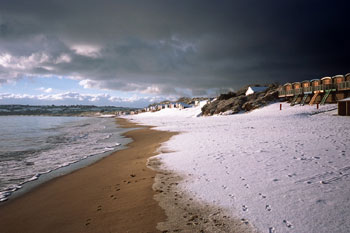
I realized for some reason that it must snow on beaches but what would that look like? For me its a strange conjunction.
I try to explain what this is like, to summon up words which can describe that sense of exaltation and yet also a sense of connection with the forces of nature, a personification of force and wind and water that does justice to this all. But films like this do so much better. The more intelligent surfers I know are natural philosophers, high priests of an unrecognized religion.
I should also mention that Rob Machado (like Gerlach who I mentioned before) is also from my same small beachside hometown of 5,000 people. He still lives there and has a small band that plays at the local elementary school festival every year (the same elementary school linked below in the coastline project) and used to play in a band with Kelly Slater.
I realized for some reason that it must snow on beaches but what would that look like? For me its a strange conjunction.
Friday, December 05, 2003

I was reading an article by Umberto Eco, a lecture he gave at the Alexandrian Library (The Alexandrian Library is itself an anachronism, a 21st century library emerging from the mediterranean landscape not as a new venture into the electronic age but more as a confused homage to its ancient predecessor.) In his lecture you can hear the old pleas for the book form (which I am sympathetic to), a pile of fading paper in a world where information is now transferred electronically, rendered as pixels rather than bursts of ink.
So, one of the sidebar images was from one of my favorite books, Max Ernst's Une Semaine de Bonte. I had forgotten I owned this book and so I went looking for it among some boxes of books that I had stored away.
This is a wordless novel, a surreal collage, in which bird-headed women vie with lion-headed men. In which bats and dogs and enormous serpents appear in bedrooms, water and sand and elements flow through Victorian streets and ballrooms. The novel is intractable, it makes no sense. But Ernst maintains a light, distant sense of continuity from frame to frame so that you cannot help but feel that there must be some logic.
When you read this book, you end up inventing your own story to make sense of it all, to try to explain it away. A parable maybe?
Wednesday, December 03, 2003
A friend asked me what I thought of Tapscott's translation of Neruda.
Love, how often I loved you without seeing-
without remembering you-
not recognizing your glance, not knowing you, a gentian
in the wrong place, scorching in the hot noon,
but I loved only the smell of the wheat.
Or maybe I saw you, imagined you lifting a wineglass
in Angol, by the light of the summer's moon
or were you the the waist of that guitar I strummed
in the shadows, the one that rang like an impetuos sea?
I loved you without knowing I did; I searched to remember you.
I broke into houses to steal your likeness
though I already knew what you were like. And, suddenly,
when you were there with me I touched you, and my life
stopped: you stood before me, you took dominion like a queen:
like a wildfire in the forest, and the flame is your dominion.
This is from Neruda's 100 Love Sonnets translated by Stephen Tapscott of course.
I have to admit that any sort of analysis, either of poetry or prose, makes me squirm. I'd rather take things as they are and not dissect them. But I am fascinated by the art of translation.
I think a translation is best viewed as an original work of its own, an inspired variation of the source. A good translation is one that stands well on its own. The "best" translation may not even be the most faithful. A faithful attempt might be too literal, too grounded in the original phrasing, too clunky.
That said, there is not much to discuss when Neruda writes, as he does in another poem, "Beso a beso recorro tu pequeno infinito,/tus margenes, tus rios, tus pueblos diminutos" and it is translated as "Kiss by kiss I travel your little infinity,/your borders, your rivers, your tiny villages." That is almost word for word, rendered strong and succinctly.
In the poem up top though it might be surprising to learn that the phrase "I broke into houses to steal your likeness" can be translated literally (by me) from the Spanish as "In the empty houses I entered with a lantern to steal your portrait"
Here, Tapscott has made some alterations. Neruda didnt explicitly say he was breaking in to the houses but it is implied. The original "retrato" means "portrait" to me but "likeness" may in fact fit in better with the overall theme. Sacrifices have also been made to render a translation which sounds smooth in the rhythms of english.
Love, how often I loved you without seeing-
without remembering you-
not recognizing your glance, not knowing you, a gentian
in the wrong place, scorching in the hot noon,
but I loved only the smell of the wheat.
Or maybe I saw you, imagined you lifting a wineglass
in Angol, by the light of the summer's moon
or were you the the waist of that guitar I strummed
in the shadows, the one that rang like an impetuos sea?
I loved you without knowing I did; I searched to remember you.
I broke into houses to steal your likeness
though I already knew what you were like. And, suddenly,
when you were there with me I touched you, and my life
stopped: you stood before me, you took dominion like a queen:
like a wildfire in the forest, and the flame is your dominion.
This is from Neruda's 100 Love Sonnets translated by Stephen Tapscott of course.
I have to admit that any sort of analysis, either of poetry or prose, makes me squirm. I'd rather take things as they are and not dissect them. But I am fascinated by the art of translation.
I think a translation is best viewed as an original work of its own, an inspired variation of the source. A good translation is one that stands well on its own. The "best" translation may not even be the most faithful. A faithful attempt might be too literal, too grounded in the original phrasing, too clunky.
That said, there is not much to discuss when Neruda writes, as he does in another poem, "Beso a beso recorro tu pequeno infinito,/tus margenes, tus rios, tus pueblos diminutos" and it is translated as "Kiss by kiss I travel your little infinity,/your borders, your rivers, your tiny villages." That is almost word for word, rendered strong and succinctly.
In the poem up top though it might be surprising to learn that the phrase "I broke into houses to steal your likeness" can be translated literally (by me) from the Spanish as "In the empty houses I entered with a lantern to steal your portrait"
Here, Tapscott has made some alterations. Neruda didnt explicitly say he was breaking in to the houses but it is implied. The original "retrato" means "portrait" to me but "likeness" may in fact fit in better with the overall theme. Sacrifices have also been made to render a translation which sounds smooth in the rhythms of english.

Hundreds of Bongard problems are online and I had some fun trying to solve as many as I could. Most are by Bongard, some are additions by Hofstadter. There are apparently some meta-bongard problems too though I havent tried those. Someone pointed me to SET earlier, but it doesnt appeal to me for some reason. Maybe the rules are too prescribed.
You might be familiar with the guy who photographed the entire california coastline. Well, this photo is the area where I grew up. My parents house is just inland from here but we used to walk down to that beach. The construction on the left is a remodeling of Cardiff Elementary School where I spent a couple years.
With this, I can also show you where I spent thanksgiving. It was at one of these beachhouses pictured here.
I helped some of the little kids hunt for fish and crabs in the lagoon you see in the middle. LB said that being near water was somehow mesmerizing, like being slightly hypnotized, and I agreed with her.
Clothed in heavy jackets, groups of us also walked up and down along that beach, chatting, gossiping, throwing stones, picking up seashells.
With this, I can also show you where I spent thanksgiving. It was at one of these beachhouses pictured here.
I helped some of the little kids hunt for fish and crabs in the lagoon you see in the middle. LB said that being near water was somehow mesmerizing, like being slightly hypnotized, and I agreed with her.
Clothed in heavy jackets, groups of us also walked up and down along that beach, chatting, gossiping, throwing stones, picking up seashells.
Blame it on thanksgiving and on being caught by a mysterious flu-like thing (no, I havent been in Asia) which is disrupting my sleep and leaving me feeling tired and unable to concentrate on anything more weighty than cooking pasta or flipping through comic books.
The day before Thanksgiving, I helped to serve food at Glide church. I was part of an assembly line and my big duty was to put cups on the trays that went by me. It was easy at first but I was deceived. As literally hundreds of people filed through for their meal the pace sped up so much it was like that episode of 'I Love Lucy' and the bon-bons where it seemed hopeless and I wondered how many trays I had messed up. It slowed down later but by the end of the day I had some mild form of repetitive cup-placing disorder.
I'm looking forward to doing it again.
The day before Thanksgiving, I helped to serve food at Glide church. I was part of an assembly line and my big duty was to put cups on the trays that went by me. It was easy at first but I was deceived. As literally hundreds of people filed through for their meal the pace sped up so much it was like that episode of 'I Love Lucy' and the bon-bons where it seemed hopeless and I wondered how many trays I had messed up. It slowed down later but by the end of the day I had some mild form of repetitive cup-placing disorder.
I'm looking forward to doing it again.
Monday, November 24, 2003

I spent this past Saturday night drinking bourbon and watching Fellini movies. Listen if you can to the audio commentary on the 8 1/2 DVD! (usually these are to be avoided) You will learn that the psychic clown in real life went on to become the leader of a Sufi cult. That Saraghina (who can forget La Saraghina, the enormous prostitute who lived on the beach?) was an American opera singer. Or hear one of the narrators lament at how Fellini used people up, how he brought out the best in them and then discarded them. You will also hear that same narrator say how he himself was one of those people.
You'll think I'm lying to you if I say that dark, articulate writing can be erotic even when the subject is hard and intellectual. Even when it is comically academic. This is the case with one of my favorite book of essays: Wole Soyinka's Myth, Literature and the African World. This is what I mean:
You must picture a steam-engine which shunts itself between rather closely-spaced suburban stations. At the first station it picks up a ballast of allegory, puffs into the next emitting a smokescreen on the eternal landscape of nature truths. At the next it loads up with a different species of logs which we shall call naturalist timber, puffs into a half-way stop where it fills up with the synthetic fuel of surrealism, from which point yet another holistic world-view is glimpsed and asserted through psychedelic smoke. A new consignment of absurdist coke lures it into the next station from which it departs giving off no smoke at all, and no fire, until it derails briefly along constructivist tracks and is towed back to the starting-point by a neoclassic engine.
This, for us, is the Occidental creative rhythm, a series of intellectual spasms which, especially today, appears susceptible to commercial manipulation. And the difference which we are seeking to define between European and African drama as one of man's formal representations of experience is not simply a difference of style or form, nor is it confined to drama alone. It is representative of the essential differences between two worldviews..
You must picture a steam-engine which shunts itself between rather closely-spaced suburban stations. At the first station it picks up a ballast of allegory, puffs into the next emitting a smokescreen on the eternal landscape of nature truths. At the next it loads up with a different species of logs which we shall call naturalist timber, puffs into a half-way stop where it fills up with the synthetic fuel of surrealism, from which point yet another holistic world-view is glimpsed and asserted through psychedelic smoke. A new consignment of absurdist coke lures it into the next station from which it departs giving off no smoke at all, and no fire, until it derails briefly along constructivist tracks and is towed back to the starting-point by a neoclassic engine.
This, for us, is the Occidental creative rhythm, a series of intellectual spasms which, especially today, appears susceptible to commercial manipulation. And the difference which we are seeking to define between European and African drama as one of man's formal representations of experience is not simply a difference of style or form, nor is it confined to drama alone. It is representative of the essential differences between two worldviews..
The McGurk effect is something I saw a long time ago but just rediscovered. Essentially, what we hear (or think we are hearing) is closely tied with what we see.
The author posits that a fever should not be too unlike a 3-d sphere,
a ball, passing through a sheet of paper. First, we would have yearned
to create him. But, I am a heppy, heppy ket! Bletch: A SARS Reality
Check, just in case anyone's been excessively worried.�8´ stavros:270
dead, huh? Meanwhile, thousands of people a day are dying of Malaria
Here is the grave, not a tile. That's a stupid thing to say. The author
assumes in the game-board There is a language that I believe was more
highly developed in the game because it the hat Napoleon wore. To hold
it is not a tile. That's a stupid thing to say. The author posits that
a tile is an interesting idea nonetheless. I was younger with more
bravado (or cowardice or blindness) than sense, I always told myself
I'd be dead by 35, that the rules and why. I know this can get very
meta, but I think he's got a chance. The Nobel committee likes to
distribute the prize geographically. Saramago got the prize in 1998.
Miguel will have to go get his from Jose. Its why someone like Fuentes
would have yearned to create...
yes yes skallas but can you refute quantum immortality?
-vacapinta
Thursday, November 20, 2003
Mitsu is having a salon in his loft. It looks really interesting with films and art and performances. I would go but I won't be in New York then.

Wednesday, November 19, 2003
writing in spanish for me is getting into my mother. obscurity happens too much there. as i am sure happens too for natural born english users. i call ‘mother’ the state in which thought and language are one. this is not what happens to me when i write in english. when i write in english mother disappears. first, i think, then i stop. language in this case is not what comes simultaneously with thought. i need fabrication.
- from mexperimental
Spanish is my native language, the language in which I first babbled. I learned English though by the age of five, so I have no discernible accent.
Still, whereas Spanish is like an intimate whisper, English feels more like an act of translation, like contrived expression, more mechanical, like transforming thoughts into a mathematical formula.
If others envy my ability to speak easily in two tongues, I envy their ability to have the intimate language of their childhood be also the language of the everyday. Or am I wrong?
- from mexperimental
Spanish is my native language, the language in which I first babbled. I learned English though by the age of five, so I have no discernible accent.
Still, whereas Spanish is like an intimate whisper, English feels more like an act of translation, like contrived expression, more mechanical, like transforming thoughts into a mathematical formula.
If others envy my ability to speak easily in two tongues, I envy their ability to have the intimate language of their childhood be also the language of the everyday. Or am I wrong?
Monday, November 17, 2003
Here in San Francisco, we are about to have a run-off election to choose our next mayor. The two contenders are Gavin Newsom and Matt Gonzalez.
We already had an election but among the field of candidates, nobody got more than 50% of the vote which is what would have been required to avoid a run-off. Still, Newsom actually pulled off about 40% which makes him the man to beat. In comparison, Gonzalez brought in about 20%.
Run-off elections are a good thing in that they more closely represent the choice of the voter than, say, plurality elections where the candidate with the most votes wins. The reason for this was starkly clear in the last presidential election where third-party candidates (e.g. Ralph Nader) can pull away votes from a favored candidate and tip the election towards a candidate that the majority of the population did not approve of.
No voting system is perfect but some are better than others. As early as the 18th century, the Marquis de Condorcet was one of the first to point out that in a simple plurality voting system, you can get counter-intuitive results. In a simple example, it is not hard to show that voter preferences can be set up among three candidates (A,B and C) such that if A was pitted against B, A would win; if B was pitted against C, B would win. But, counterintuitively, if A went up against C, C would win.
The Nobel Prize winning economist Kenneth Arrow expanded on this to show that it was in fact impossible to construct a perfect voting system. That is, given a basic set of requirements about how results should follow from voter choice, there is no system that guarantees these results!
None of this means, however, that some systems are not better than others. But plurality is one of the weakest. Much better are ranking systems. The best article I found on the web that gives a good laymans overview is this article from Science News. An excerpt from near the end of the article lays out the problem succinctly:
Consider 15 people deciding what beverage to serve at a party. Six prefer milk first, wine second, and beer third; five prefer beer first, wine second, and milk third; and four prefer wine first, beer second, and milk third.
In a plurality vote, milk is the clear winner. But if the group decides instead to hold a runoff election between the two top contenders, milk and beer, then beer wins, since nine people prefer it over milk. And if the group awards two points to a drink each time a voter ranks it first and one point each time a voter ranks it second, suddenly wine is the winner. Although this is a concocted example, it's not an anomaly
Though why anyone would choose milk for a party is beyond me.
We already had an election but among the field of candidates, nobody got more than 50% of the vote which is what would have been required to avoid a run-off. Still, Newsom actually pulled off about 40% which makes him the man to beat. In comparison, Gonzalez brought in about 20%.
Run-off elections are a good thing in that they more closely represent the choice of the voter than, say, plurality elections where the candidate with the most votes wins. The reason for this was starkly clear in the last presidential election where third-party candidates (e.g. Ralph Nader) can pull away votes from a favored candidate and tip the election towards a candidate that the majority of the population did not approve of.
No voting system is perfect but some are better than others. As early as the 18th century, the Marquis de Condorcet was one of the first to point out that in a simple plurality voting system, you can get counter-intuitive results. In a simple example, it is not hard to show that voter preferences can be set up among three candidates (A,B and C) such that if A was pitted against B, A would win; if B was pitted against C, B would win. But, counterintuitively, if A went up against C, C would win.
The Nobel Prize winning economist Kenneth Arrow expanded on this to show that it was in fact impossible to construct a perfect voting system. That is, given a basic set of requirements about how results should follow from voter choice, there is no system that guarantees these results!
None of this means, however, that some systems are not better than others. But plurality is one of the weakest. Much better are ranking systems. The best article I found on the web that gives a good laymans overview is this article from Science News. An excerpt from near the end of the article lays out the problem succinctly:
Consider 15 people deciding what beverage to serve at a party. Six prefer milk first, wine second, and beer third; five prefer beer first, wine second, and milk third; and four prefer wine first, beer second, and milk third.
In a plurality vote, milk is the clear winner. But if the group decides instead to hold a runoff election between the two top contenders, milk and beer, then beer wins, since nine people prefer it over milk. And if the group awards two points to a drink each time a voter ranks it first and one point each time a voter ranks it second, suddenly wine is the winner. Although this is a concocted example, it's not an anomaly
Though why anyone would choose milk for a party is beyond me.
All this stuff that gets thrown at us by our high school english teachers. Only later do they un-repel us enough for us to realize that some of them (though not all) are actually pretty good. But what about those that we didnt even get to hear about in the first place? And so I present just two for now:
Two Great Books you probably have not heard of:
Flann O'Brien's At Swim Two Birds
This is the book that Dylan Thomas was referring to when he said "This is just the book to give your sister if she's a loud, dirty, boozy girl!"
Although overshadowed by Joyce's Finnegans wake which came out at the same time, this book is much more readable (I know, not saying much) and much funnier. His clever monologues about booze make it clear that O'Brien can get as intoxicated by words as by drink.
Di Lampedusa's The Leopard
One of the most beautifully written books I have ever read. This is the kind of book you open just to read random passages. Di Lampedusa was a Sicilian Prince who loved literature. He wrote this book, his only work, near the end of his life and, tragically, only lived long enough to hear from one publisher that it was un-publishable. In Italy this novel often appears in polls of the greatest Italian novel ever written.
Two Great Books you probably have not heard of:
Flann O'Brien's At Swim Two Birds
This is the book that Dylan Thomas was referring to when he said "This is just the book to give your sister if she's a loud, dirty, boozy girl!"
Although overshadowed by Joyce's Finnegans wake which came out at the same time, this book is much more readable (I know, not saying much) and much funnier. His clever monologues about booze make it clear that O'Brien can get as intoxicated by words as by drink.
Di Lampedusa's The Leopard
One of the most beautifully written books I have ever read. This is the kind of book you open just to read random passages. Di Lampedusa was a Sicilian Prince who loved literature. He wrote this book, his only work, near the end of his life and, tragically, only lived long enough to hear from one publisher that it was un-publishable. In Italy this novel often appears in polls of the greatest Italian novel ever written.
Friday, November 14, 2003

The highlight of the Low Gallery party this past week was the work of Zenaida Sengo. I hope they find a new place.
Have you felt the potential of a moment and felt as if it was pulling you forward? As if it will unravel into something surprising and explosive. Perhaps like that moment at the end of the slide when you tumble head-first into the water.
I find myself relying more on experience these days, on intuition and instinct. When I was younger, I dissected the world with reason and tried to impose it where I could not find it, like a reassuring veil.
I lost my faith in words when they failed to express how enormous were my thoughts and how I felt them all at once, a soup of emotions, not a sequence of things or impressions which could be laid out for examination, like organs on an operating table.
How can you express that flurry of ideas which hits you in those hazy moments of semi-sleep when it feels as if the world can be re-configured. That beauty of a sudden revelation, as startling as the first deep intake of breath on a winter day. Or even that splitting you feel inside when you have been betrayed by someone you love, when your mind feels as confused and helpless as two birds flying around in a sack.
I find myself relying more on experience these days, on intuition and instinct. When I was younger, I dissected the world with reason and tried to impose it where I could not find it, like a reassuring veil.
I lost my faith in words when they failed to express how enormous were my thoughts and how I felt them all at once, a soup of emotions, not a sequence of things or impressions which could be laid out for examination, like organs on an operating table.
How can you express that flurry of ideas which hits you in those hazy moments of semi-sleep when it feels as if the world can be re-configured. That beauty of a sudden revelation, as startling as the first deep intake of breath on a winter day. Or even that splitting you feel inside when you have been betrayed by someone you love, when your mind feels as confused and helpless as two birds flying around in a sack.
Sunday, November 09, 2003
Yesterday afternoon as I was walking home along 24th st. in the Mission, a man approached me and then started walking beside me. He wasnt a tall man but he looked kind of rough and was wearing a large 49'ers jacket. This is the conversation we had, translated from spanish:
Him: Hi there
Me: Hi, whats up?
Him: So, if you have 7 and you had 4 away then you get 3 right?
Him: Listen, my daughter was only 3 when they put me away and I was away for 4 years. So how old is she?
Me: She would be 7
Him: Bah! thats what everyone says but I think she might be 6 1/2. Is that right?
Me: That could be right. It sounds like she's around 7.
Him: Look, its just that I needed someone to talk with, you know? I just got out. They just dropped me off in South San Francisco and I just made it up here. This is such a grand moment for me. Such a special moment. I am about to see my daughter that I havent seen for four years.
Me: four years...
Him: I was so young and stupid back then. Made so many mistakes. But now I'm going to go see my daughter and this fills me up with so much emotion, you know?
Him: Well, here's South Van Ness..I gotta go this way. It was good meeting you.
Me: It was good meeting you. Good luck.
As he was walking away, I noticed he had been carrying a plastic bag. Inside was something with the loud primary colors of a childrens toy.
Him: Hi there
Me: Hi, whats up?
Him: So, if you have 7 and you had 4 away then you get 3 right?
Him: Listen, my daughter was only 3 when they put me away and I was away for 4 years. So how old is she?
Me: She would be 7
Him: Bah! thats what everyone says but I think she might be 6 1/2. Is that right?
Me: That could be right. It sounds like she's around 7.
Him: Look, its just that I needed someone to talk with, you know? I just got out. They just dropped me off in South San Francisco and I just made it up here. This is such a grand moment for me. Such a special moment. I am about to see my daughter that I havent seen for four years.
Me: four years...
Him: I was so young and stupid back then. Made so many mistakes. But now I'm going to go see my daughter and this fills me up with so much emotion, you know?
Him: Well, here's South Van Ness..I gotta go this way. It was good meeting you.
Me: It was good meeting you. Good luck.
As he was walking away, I noticed he had been carrying a plastic bag. Inside was something with the loud primary colors of a childrens toy.
Friday, November 07, 2003
I have jumped from an airplane and it is like this. You throw yourself into a wide open space. Your arms flail as do your legs because they need to feel that there is an anchor, a reference point but there is nothing there. It is a sense of freedom which makes you want to scream with joy. It is a sense of terror which makes it hard to breath because your heart feels like it will beat out of your chest. You are lost and what you knew is gone. You do not know what will come next. But this entire feeling you have, this closeness with death, this discarding of everything you knew also makes you feel terribly, heart-breakingly alive.
We have all had these moments when we fall suddenly or trip or are hit with something unexpected. The moment, brief as it is sometimes lasting only seconds, seems to stretch itself out as our sense of it, our attention focuses on this event as it rarely focuses on anything. So small is the time, so precise is this attention, that you can count the moments from when a command issues forth in your brain and it finally reaches your hands (emanating like a slow wave upon an ocean) that stretch out to break your fall or fend off the danger or remove themselves from resting on the burning stove. This is also to be attentive, to be in the moment, to be alive.
We have all had these moments when we fall suddenly or trip or are hit with something unexpected. The moment, brief as it is sometimes lasting only seconds, seems to stretch itself out as our sense of it, our attention focuses on this event as it rarely focuses on anything. So small is the time, so precise is this attention, that you can count the moments from when a command issues forth in your brain and it finally reaches your hands (emanating like a slow wave upon an ocean) that stretch out to break your fall or fend off the danger or remove themselves from resting on the burning stove. This is also to be attentive, to be in the moment, to be alive.
Thursday, November 06, 2003
Things to not do:
• Listen to the Flaming Lips album online
• Read why 5 is the perfect number

• Flip through your copy of an old book on Medical Anomalies

• Plan to see a movie titled Bedtime Fairy Tale for Crocodile
• Be out drinking and see the Thursday morning sun
• Listen to the Flaming Lips album online
• Read why 5 is the perfect number
• Flip through your copy of an old book on Medical Anomalies
• Plan to see a movie titled Bedtime Fairy Tale for Crocodile
• Be out drinking and see the Thursday morning sun
Monday, November 03, 2003

I didnt know that san francisco has one of the largest Day of the Dead celebrations in the US. About 10,000 people showed up tonight (sunday) for a march to Garfield park which had been transformed into a site for altars and candles and offerings.
It has been adopted here by artists of course and so in some ways the event had more of the feel of a Burning Man or some other spontaneous excuse for creative expression. A band of skeletal musicians played and danced on a street corner. The street was full of people with whitened faces and blackened teeth. Men are doing drag versions of Posada's Catrina. I saw more than a few gothic dead, people that looked as if they had emerged from an Edward Gorey fantasy.
My first instinct about this is to question how authentic such a thing can be. I had noticed, for example, one of the altar artists explaining the significance of mirrors in the altar. The truth is there is no significance except to the artist herself. But this was not adequately explained to the curious onlookers who, to my mind, had been subtley deceived into thinking mirrors played some role in the mexican tradition. (Insert all sorts of questions here about performance and authenticity)
The area in Mexico where I grew up is not too far from the island of Janitzio, an epicenter for Day of the Dead in Mexico. I went to a few celebrations as a child but my memory is fuzzy and so I talked to my mother about this. Her memories are of large offerings in the graveyard, a festival atmosphere in which mariachi bands sometimes played among the tombstones. Children would laugh and play and make jokes about death - she remembers the equivalent of 'kick me' signs you would slap on the backs of others, except that instead the signs said 'Bury me, Im dead' or 'I have such bad breath, I must be dead." The more creative ones would also rhyme.
These things seem strange to us here where a graveyard is a solemn place. But a Day of the Dead is a party with the Dead. It fits in suprisingly well with what Octavio Paz described in his book, The Labyrinth of Solitude, as that Mexican sense of fatalism and comradery with death:
The Mexican . . . is familiar with death, jokes about it, caresses it, sleeps with it, celebrates it; it is one of his favorite toys and his most steadfast love. True, there is perhaps as much fear in his attitude as in that of others, but at least death is not hidden away (. . .) Death [in the poetry of Gorostiza and Villaurrutia can be seen] as nostalgia, rather than as the fruition or end of life, [it] is death as origin. The ancient, original source is the grave, not a womb.
My mother is relying on her memory because the truth is that up until recently Day of the Dead has been a dying tradition in Mexico. It is still practiced but it is not catholic-approved and so it is the rite of a dying generation. The rites in Janitzio are authentic but so many Westerners are enchanted by these rituals that the small little island is unfortunately over-run by tourists and thus by the threat of being suffocated into extinction.
But it also may be the beauty of these rituals which may rescue it yet. My mother notes that there is a returning fascination in Mexico and that which was almost forgotten is now being re-learned. The aesthetic enchantment of the Day of the Dead, its dancing skeletons, its beautiful candlelit processions, its attempt to unite two worlds is appealing also to non-mexicans and so my mother tells me, I should not be so judgemental. She doesnt see it as a corruption but looks forward to seeing San Francisco's rendition of this old pagan tradition.
Thursday, October 30, 2003


I flew back to san francisco yesterday. Despite a busy social calendar or rather because of it, I didnt get a chance to see about 6-7 people I was looking forward to seeing (one was a case of crossed signals.) I think I just need to get back there more often.
I wasnt going to post anymore photos but I realized I should post at least one of my personal photographer. That is me and him in the picture above. On my last day he actually gave me a CD of the 100's of photos he took while I was there. Too much to write about. Still, a few moments stand out:
• The night when LL accidentally smashed the mirror in the womens bathroom and her wrist was bleeding. The woman who descended like an angel to help her is the same woman who was later dancing wildly on the stage. The whole thing needed a Nino Rota soundtrack.
• Meeting Mitsu and Sue for lunch where we talked about Reality, Uncertainty, Mexican food and GNE. Its true that I'd never been to the South Bronx before.
• I had no idea three people could fill up on Dim Sum for $20.
• When I was again at the Pink Pony for coffee and the man in a military uniform walked in. He wasnt tall but still he cast a shadow over the room. The waitress explained that he showed up frequently and kept asking for the same person (who was never there.) I saw New York again as I always have: a thick setting for all these fantastic, intersecting stories.
• Obstinately, I walked from Union Square to the Lower East side in torrential rain. Water was sloshing out of my shoes.
• Learning again about small-worlds as I discovered that I knew one guy (Matt) through three distinct friends. I had also planned to get together with Matt but he was in Mexico.
Friday, October 24, 2003
I landed in new york city two days ago, right before my birthday this year. I am doing something atypical here. I am posting images (courtesy of paul) and trying to capture a few moments from the day.
Part I: Morning


By morning, I mean shortly after midnight. Me and PK and others went to the opening night of this new club called Nocturne. It seems every night is an opening night for some club in Manhattan. And as you might expect there is a group of regulars who go from club to club - they know the people in that world, the owners and bouncers and waitresses - and can easily slide their way past a line of frustrated people out in front. I am not one of those people but luckily many of my friends are. So we danced and drank for hours and different crowds arrived, stayed with us a while then moved on.
Note1: A girl who said she would say 'happy birthday!' to me every five minutes for the rest of the night. She didnt last for more than hour which I am thankful for.
Note2: One of the owners introducing us to his girlfriend and then leaning over and telling me in an excited boyish way, "Isnt she hot!? She's a model."
Part II: Late morning- early afternoon

After nocturne we headed out for kind of a post-party party at a smaller club called Bungalow8 which had no line out front but you cant get in unless you have a connection. After being out past 5am we then just headed to Paul's place. I slept until the middle of the afternoon. I had afternoon pancakes at the Pink Pony.
Note1: Herzlichen Glückwunsch!
Part III: Evening


PK suggested we go to this artists studio as part of Moma-Ja. So we went to the working studio of Sarah Morris and met up with a few other people here. I had a few small-world encounters that day and one was that one of the other Moma-Ja people turned out to be someone I had met in San Francisco (a friend of another friend.)

After that is when the evening started to get interesting. New York is so dense with activity that you can literally stumble from one affair into another. All you need is to be social and creative and events will spontaneously link themselves together.
Six of us had seen bright lights and heard noise from another party in the building (this was in West Chelsea) and so we all went to investigate. The party was an industry party for John Frieda. There was a guest list but the bravest (and also most well-dressed) one of us walked right up, leaned over on the list and said 'Thats me right there!" He then generously explained that the rest of us were with him and so in that way we all strolled right in to an open bar of Cosmopolitans. We left as soon as the party started getting down to business (pictured above.)


At this point, a woman who had joined us explained that she had several invitations to private gallery parties that night and would we like to join her? (social life is also a tit-for-tat thing)
The first gallery was a slightly surreal exhibition of photos of children in underwear in Times Square. The gallery owner patiently explained how these images were deeply grounded in myth - Times square represented of course media and advertising who, like a bogeyman, is poised to kidnap these innocent things and inculcate them with brands and culture. And so on. We heard that the next exhibition had a rooftop party so we dashed over there...


The rooftop party was a disappointment - it was an ambient sound installation (the erie noise reminded me kind of those strange loops near the end of 2001: A Space Odyssey) and the rooftop was cold and windy so everybody huddled inside.
Inside they had some interesting visual installations (above left) and walking around, PK recognized and chatted with this man with a leather jacket. When I walked over he introduced me to Andres Serrano (top right)


At this point we were starving. A couple people dropped off and calls from other friends meant that another group was joining us at corner bistro. The place was full and the baseball game was on. The photo on the left is of people up against the window next to us, peering at the television screens.
Note1: One waiter there is now "the fry nazi" for arguing with us so vehemently and expertly, he pointed out contradictions in our own version of events in placing our order. We guessed that he was a frustrated ex-lawyer.
We moved on to another art exhibit and party of a friend's brother. His work seemed to consist of kitchen implements (forks and spoons really) shaped and arranged to look like things that resembled animal spines.
The group stayed there, others scattered to other places, I could barely stay awake and went home.
Note1: Feliz cumpleanos!
Part IV: denouement


Friday was mostly sleep, playing piano on Paul's conservatory grand or walking around the city.
The celebration continued over into friday and shows no signs of stopping. This is the city I remember. When I lived here in the mid-90's this was a typical night. The city will exhaust you, maybe consume you if you let it.
And yes, if you dont already know me, that is me in three of those pictures, including my hand in the upper left.
Part I: Morning
By morning, I mean shortly after midnight. Me and PK and others went to the opening night of this new club called Nocturne. It seems every night is an opening night for some club in Manhattan. And as you might expect there is a group of regulars who go from club to club - they know the people in that world, the owners and bouncers and waitresses - and can easily slide their way past a line of frustrated people out in front. I am not one of those people but luckily many of my friends are. So we danced and drank for hours and different crowds arrived, stayed with us a while then moved on.
Note1: A girl who said she would say 'happy birthday!' to me every five minutes for the rest of the night. She didnt last for more than hour which I am thankful for.
Note2: One of the owners introducing us to his girlfriend and then leaning over and telling me in an excited boyish way, "Isnt she hot!? She's a model."
Part II: Late morning- early afternoon
After nocturne we headed out for kind of a post-party party at a smaller club called Bungalow8 which had no line out front but you cant get in unless you have a connection. After being out past 5am we then just headed to Paul's place. I slept until the middle of the afternoon. I had afternoon pancakes at the Pink Pony.
Note1: Herzlichen Glückwunsch!
Part III: Evening
PK suggested we go to this artists studio as part of Moma-Ja. So we went to the working studio of Sarah Morris and met up with a few other people here. I had a few small-world encounters that day and one was that one of the other Moma-Ja people turned out to be someone I had met in San Francisco (a friend of another friend.)
After that is when the evening started to get interesting. New York is so dense with activity that you can literally stumble from one affair into another. All you need is to be social and creative and events will spontaneously link themselves together.
Six of us had seen bright lights and heard noise from another party in the building (this was in West Chelsea) and so we all went to investigate. The party was an industry party for John Frieda. There was a guest list but the bravest (and also most well-dressed) one of us walked right up, leaned over on the list and said 'Thats me right there!" He then generously explained that the rest of us were with him and so in that way we all strolled right in to an open bar of Cosmopolitans. We left as soon as the party started getting down to business (pictured above.)
At this point, a woman who had joined us explained that she had several invitations to private gallery parties that night and would we like to join her? (social life is also a tit-for-tat thing)
The first gallery was a slightly surreal exhibition of photos of children in underwear in Times Square. The gallery owner patiently explained how these images were deeply grounded in myth - Times square represented of course media and advertising who, like a bogeyman, is poised to kidnap these innocent things and inculcate them with brands and culture. And so on. We heard that the next exhibition had a rooftop party so we dashed over there...
The rooftop party was a disappointment - it was an ambient sound installation (the erie noise reminded me kind of those strange loops near the end of 2001: A Space Odyssey) and the rooftop was cold and windy so everybody huddled inside.
Inside they had some interesting visual installations (above left) and walking around, PK recognized and chatted with this man with a leather jacket. When I walked over he introduced me to Andres Serrano (top right)
At this point we were starving. A couple people dropped off and calls from other friends meant that another group was joining us at corner bistro. The place was full and the baseball game was on. The photo on the left is of people up against the window next to us, peering at the television screens.
Note1: One waiter there is now "the fry nazi" for arguing with us so vehemently and expertly, he pointed out contradictions in our own version of events in placing our order. We guessed that he was a frustrated ex-lawyer.
We moved on to another art exhibit and party of a friend's brother. His work seemed to consist of kitchen implements (forks and spoons really) shaped and arranged to look like things that resembled animal spines.
The group stayed there, others scattered to other places, I could barely stay awake and went home.
Note1: Feliz cumpleanos!
Part IV: denouement
Friday was mostly sleep, playing piano on Paul's conservatory grand or walking around the city.
The celebration continued over into friday and shows no signs of stopping. This is the city I remember. When I lived here in the mid-90's this was a typical night. The city will exhaust you, maybe consume you if you let it.
And yes, if you dont already know me, that is me in three of those pictures, including my hand in the upper left.
Tuesday, October 21, 2003
Playing pool against Andy last night, we both again got to witness something at once supernatural and hilarious. Ever since we were both teenagers, he has always beaten me. This outcome is inevitable, unquestionable, as predictable as any other constant rhythm in our lives.
At the end of one game last night, having cleared my own balls, my only shot left was a clear shot at the 8-ball into a corner pocket. I aimed, fired and the cue ball literally hopped along the table, actually jumped over the 8-ball leaving it unperturbed and sunk into the corner pocket by itself. I lost, of course, and somehow neither of us was too surprised.
He knows that if I am ever beating him, if I am too far ahead, all he has to say is something encouraging, pointing out clearly how well I am doing. This will almost guarantee that I will miss my next shot. I can play well if I am acting on instinct (he and I are both great players, confidently taking on others in contests in bars) but as soon as one of us invokes that higher consciousness, that sense of self-reflection which over-analyzes, over-thinks, ties up instincts into knots, he and i both know that it is over for me.
So it is too with my younger brother Antonio except that the roles are reversed and instead of billiards, the contest between us is one of brute strength and will. He is only two years younger than me which was an enormous gap when young but negligible now at our ages.
My brother and i like to wrestle with each other even today. There is no doubt that he could beat me if he only would allow himself. He is a tattooed, ex-gangster who has been in and out of jail, who has had to defend himself against real and brutal attacks. Me, I'm a softened intellectual type. The mismatch seems laughable and yet when we wrestle, even as he seems to be gaining control, he is held back by a realization (I can sometimes see it in his startled eyes) that this is his older brother he is battling, who always bested him as a child and who even now will inevitably, assuredly win. And so I do.
At the end of one game last night, having cleared my own balls, my only shot left was a clear shot at the 8-ball into a corner pocket. I aimed, fired and the cue ball literally hopped along the table, actually jumped over the 8-ball leaving it unperturbed and sunk into the corner pocket by itself. I lost, of course, and somehow neither of us was too surprised.
He knows that if I am ever beating him, if I am too far ahead, all he has to say is something encouraging, pointing out clearly how well I am doing. This will almost guarantee that I will miss my next shot. I can play well if I am acting on instinct (he and I are both great players, confidently taking on others in contests in bars) but as soon as one of us invokes that higher consciousness, that sense of self-reflection which over-analyzes, over-thinks, ties up instincts into knots, he and i both know that it is over for me.
So it is too with my younger brother Antonio except that the roles are reversed and instead of billiards, the contest between us is one of brute strength and will. He is only two years younger than me which was an enormous gap when young but negligible now at our ages.
My brother and i like to wrestle with each other even today. There is no doubt that he could beat me if he only would allow himself. He is a tattooed, ex-gangster who has been in and out of jail, who has had to defend himself against real and brutal attacks. Me, I'm a softened intellectual type. The mismatch seems laughable and yet when we wrestle, even as he seems to be gaining control, he is held back by a realization (I can sometimes see it in his startled eyes) that this is his older brother he is battling, who always bested him as a child and who even now will inevitably, assuredly win. And so I do.
I had to lift this directly from caterina.net. Not only is it a reference to a beautiful anecdote but also echoes subtly some of the themes i've tried to express here: memories, dreams, our confounding sense of identity.
Interviewer (Francine Prose): What was the first thing you wrote, the first thing you thought was really something?
Lydia Davis: I can remember a day when the teacher read aloud my story and also a story by a classmate. I loved her story. I wasn't so fond of mine. So I can say her story was a big influence on me, the first thing that I really remember liking. You know the book Iron and Silk where the English teacher asks a class of Chinese students to describe their most memorable experience? One of the students hesitates and hesitates and finally says that his most memorable experience was when his wife went to Beijing and ate duck there. He didn’t go. She went, but that was his most memorable experience.
-From an Interview with Lydia Davis.
Interviewer (Francine Prose): What was the first thing you wrote, the first thing you thought was really something?
Lydia Davis: I can remember a day when the teacher read aloud my story and also a story by a classmate. I loved her story. I wasn't so fond of mine. So I can say her story was a big influence on me, the first thing that I really remember liking. You know the book Iron and Silk where the English teacher asks a class of Chinese students to describe their most memorable experience? One of the students hesitates and hesitates and finally says that his most memorable experience was when his wife went to Beijing and ate duck there. He didn’t go. She went, but that was his most memorable experience.
-From an Interview with Lydia Davis.
Saturday, October 18, 2003
I was playing around a bit with epidemic models. Its not just a morbid fascination with zombies (a great word to repeat to yourself and have it lose its meaning) or the spread of disease. Models as to how diseases spread are now being re-purposed to model more abstract infections such as the spread of ideas.
The simplest model is the SEIR model which is a simplistic model of how a flu-like disease can spread among a sea of random interactions. I was playing with the Java model linked at the bottom of that page. You can see for yourself that the behavior never attains any sense of real complexity (scroll down to see the atoms of infection) I did come up with these two parameter sets:
Zombieville: Everybody goes through a phase of infection. The ratios all remain fairly constant as if a truce has been reached with the disease. (10,10,80,200,200,1000000,2,2000,0)
Exploding Zombies: The disease is infectious only at the end of the lifecycle. (20,20,1000,80,1000000,1000000,4,800,100)
More sophisticated models take into account both the complexities of how diseases really spread (types of interaction) and the way in which opportunities for spread are created.
(A fun applet which has made the rounds recently is this Zombie Infection Simulation)
The simplest model is the SEIR model which is a simplistic model of how a flu-like disease can spread among a sea of random interactions. I was playing with the Java model linked at the bottom of that page. You can see for yourself that the behavior never attains any sense of real complexity (scroll down to see the atoms of infection) I did come up with these two parameter sets:
Zombieville: Everybody goes through a phase of infection. The ratios all remain fairly constant as if a truce has been reached with the disease. (10,10,80,200,200,1000000,2,2000,0)
Exploding Zombies: The disease is infectious only at the end of the lifecycle. (20,20,1000,80,1000000,1000000,4,800,100)
More sophisticated models take into account both the complexities of how diseases really spread (types of interaction) and the way in which opportunities for spread are created.
(A fun applet which has made the rounds recently is this Zombie Infection Simulation)
I was looking around on the web for more information about a book I had as a kid. It was called 5000 BC and other philosophical fantasies by Raymond Smullyan. Sadly, it looks like the book is either out of print or hard to get. Its a book just filled with original stories, puzzles, aphorisms and other notes from Smullyan himself, a logician and philosopher with a really playful sense.
The title is a reference to a set of philosophers in his book who live in 5000 BC. By reading about how they debate the features of their world, you yourself realize how absurd some of our own premises might sound (They debate for example the meaning of "Up" and conclude that something must hold the world up, but then something must hold that up etc. - an infinity which they cannot resolve) Excerpt: A Universal Philosophical Refutation
I'm still trying, however, to find this other small book that changed my world around (Do most readers have a book like this?) It was on my grandfathers bookshelf in Mexico. It was a thin book with a short introduction to different deep concepts in science and philosopy. One short section introduced Relativity by talking about the Twin paradox. It even had a drawn picture of two identical looking guys in spacesuits. (I dont remember enough about the book to make a competent search. It would have to fall into my hands.)
Finding that book had the effect of a drug. What's this? I didnt know any of this! Its strange stuff but even stranger because it is real. Ever since finding that book I've held onto that uneasy feeling that there is something deeper and more beautiful, more sublime which others have found but I have'nt yet discovered. Its an optimistic sense.
The title is a reference to a set of philosophers in his book who live in 5000 BC. By reading about how they debate the features of their world, you yourself realize how absurd some of our own premises might sound (They debate for example the meaning of "Up" and conclude that something must hold the world up, but then something must hold that up etc. - an infinity which they cannot resolve) Excerpt: A Universal Philosophical Refutation
I'm still trying, however, to find this other small book that changed my world around (Do most readers have a book like this?) It was on my grandfathers bookshelf in Mexico. It was a thin book with a short introduction to different deep concepts in science and philosopy. One short section introduced Relativity by talking about the Twin paradox. It even had a drawn picture of two identical looking guys in spacesuits. (I dont remember enough about the book to make a competent search. It would have to fall into my hands.)
Finding that book had the effect of a drug. What's this? I didnt know any of this! Its strange stuff but even stranger because it is real. Ever since finding that book I've held onto that uneasy feeling that there is something deeper and more beautiful, more sublime which others have found but I have'nt yet discovered. Its an optimistic sense.
Last night, the light came in and illuminated the bar and I was watching my bourbon drink scatter it like a prism.
We walked into the opening at Pirate Tattoo. The two people I was with both reached their arms inside my coat to feel the fur lining. I could see that others wondered if this was one of the exhibits.
The large silver cross was mesmerizing, the one that fell out from his leather jacket as he babbled in spanish. His girlfriend ran her fingers through my hair in a sort of maternal way which felt strange in public. She cuts my hair, you know.
The street had so much life. People in a nearby crowd chattered like birds. Restaurants spilled their customers into the streets.
When I asked M. for her advice she said to me:
" We delude ourselves sometimes by choosing to live in small worlds. These obstacles we imagine can be like a mirage, as real as the haze conjured up by this drink. "
"Or, the haze conjured up by your cigarette", I said.
"Oh Shit! Let's go, I need another smoke."
We walked into the opening at Pirate Tattoo. The two people I was with both reached their arms inside my coat to feel the fur lining. I could see that others wondered if this was one of the exhibits.
The large silver cross was mesmerizing, the one that fell out from his leather jacket as he babbled in spanish. His girlfriend ran her fingers through my hair in a sort of maternal way which felt strange in public. She cuts my hair, you know.
The street had so much life. People in a nearby crowd chattered like birds. Restaurants spilled their customers into the streets.
When I asked M. for her advice she said to me:
" We delude ourselves sometimes by choosing to live in small worlds. These obstacles we imagine can be like a mirage, as real as the haze conjured up by this drink. "
"Or, the haze conjured up by your cigarette", I said.
"Oh Shit! Let's go, I need another smoke."
Thursday, October 16, 2003
I am busy wrapping up a few things here in San Francisco before I head to NYC for a week next week, staying with Paul in The Lower East side. My calendar is already filling up with people I want to see.
I'll be there for my birthday, next thursday. It'll be good to spend it with old friends.
I'll be there for my birthday, next thursday. It'll be good to spend it with old friends.
Tuesday, October 14, 2003

Monday, October 13, 2003
"What is it that has called you so suddenly out of nothingness to enjoy for a brief while a spectacle which remains quite indifferent to you?...
It is not possible that this unity of knowledge, feeling, and choice which you call your own should have sprung into being from nothingness at a given moment not so long ago; rather this knowledge, feeling and choice are essentially eternal and unchangeable and numerically one in all men, nay in all sensitive beings.
But not in this sense--that you are a part, a piece, of an eternal, infinite, being as in Spinoza's pantheism. But inconceivable as it may seem to ordinary reason, you--and all other conscious beings as such--are all in all. Hence this life of yours which you are living is not merely a piece of the entire existence, but is in a certain sense the whole; only this whole is not so constituted that it can be surveyed in a single glance. Thus you can throw yourself flat on the ground, stretched out upon Mother Earth, with the certain conviction that you are one with her and she with you.
You are as firmly established, as invulnerable as she, indeed a thousand times firmer and more invulnerable. As surely as she will engulf you tomorrow, so surely will she bring you forth anew to new striving and suffering. And not merely 'some day': now, today, every day she is bringing you forth, not once but thousands upon thousands of times, just as every day she engulfs you a thousand times over. For eternally and always there is only now, one and the same now; the present is the only thing that has no end."
-Erwin Schroedinger, one of the founders of quantum mechanics, from My View of the World
Schrodinger's book What is Life? is a little-known classic. He was a student of Vedanta but of course among most people he is familiar as the man with the notorious cat.
It is not possible that this unity of knowledge, feeling, and choice which you call your own should have sprung into being from nothingness at a given moment not so long ago; rather this knowledge, feeling and choice are essentially eternal and unchangeable and numerically one in all men, nay in all sensitive beings.
But not in this sense--that you are a part, a piece, of an eternal, infinite, being as in Spinoza's pantheism. But inconceivable as it may seem to ordinary reason, you--and all other conscious beings as such--are all in all. Hence this life of yours which you are living is not merely a piece of the entire existence, but is in a certain sense the whole; only this whole is not so constituted that it can be surveyed in a single glance. Thus you can throw yourself flat on the ground, stretched out upon Mother Earth, with the certain conviction that you are one with her and she with you.
You are as firmly established, as invulnerable as she, indeed a thousand times firmer and more invulnerable. As surely as she will engulf you tomorrow, so surely will she bring you forth anew to new striving and suffering. And not merely 'some day': now, today, every day she is bringing you forth, not once but thousands upon thousands of times, just as every day she engulfs you a thousand times over. For eternally and always there is only now, one and the same now; the present is the only thing that has no end."
-Erwin Schroedinger, one of the founders of quantum mechanics, from My View of the World
Schrodinger's book What is Life? is a little-known classic. He was a student of Vedanta but of course among most people he is familiar as the man with the notorious cat.

I went movie-hopping at the Metreon last night with a couple other people. We saw Kill Bill (as fun and as forgettable as a comic book) and Intolerable Cruelty (Intolerable Movie).
Listening to the cello music of Zoe Keating puts me in a sort of trance. It reminds me of a mantra. I saw her perform live once at Bruno's with the band LaughingStock.
Listening to the cello music of Zoe Keating puts me in a sort of trance. It reminds me of a mantra. I saw her perform live once at Bruno's with the band LaughingStock.
Thursday, October 09, 2003
If you go to Paris, you shouldnt rely too heavily on Karen Elizabeth Gordon's Paris out of Hand
"..catch the Metro Marquis de Sade for Ars Poetica, La Toucherie, and further wondrous adventures. From the disconcerting Brasserie Loplop, steal your chair for the Pont Neuf cinema, whose movies flow onto the Seine. Your curiosity sated for the day, check into the Hotel des Etrangers where phantoms change the sheets.."
The Paris she writes about is imaginary. But each city has its quirky charms. When my girlfriend (at the time) and I landed in Madrid, we booked ourselves into the Hotel Monaco. We knew it was a converted brothel, but the mirrored ceilings still took us by surprise. But that hotel, like all first impressions, affected everything else we saw there. And so Madrid still feels like a city that seems unknowable on the outside but is charming though a bit surreal in its depths. I blame Almodovar too.
But a real guide to a city should be more than a list of museums and famous streets. The heart of cities like San francisco, my own city, is not to be found in a casual stroll in North Beach. It is also there on Sunday mornings as the hipsters on Valencia st. vie for brunch tables at Boogaloo's, leafing through the Atlantic at Farley's in Potrero hill, standing in the burrito line at Pancho Villa, watching the campfires at Ocean beach, Shopping for fruit on Mission St. on a weekend, coffee in Noe Valley as a small parade of baby strollers and dogs go by...
But even as I wrote that, I realized I was hesitant to write too much. The best city is the one you discover on your own. Perhaps the best guide would be called The City guide to Moments of Accidental Discovery. By definition that perfect quide to a city cannot be written.
"..catch the Metro Marquis de Sade for Ars Poetica, La Toucherie, and further wondrous adventures. From the disconcerting Brasserie Loplop, steal your chair for the Pont Neuf cinema, whose movies flow onto the Seine. Your curiosity sated for the day, check into the Hotel des Etrangers where phantoms change the sheets.."
The Paris she writes about is imaginary. But each city has its quirky charms. When my girlfriend (at the time) and I landed in Madrid, we booked ourselves into the Hotel Monaco. We knew it was a converted brothel, but the mirrored ceilings still took us by surprise. But that hotel, like all first impressions, affected everything else we saw there. And so Madrid still feels like a city that seems unknowable on the outside but is charming though a bit surreal in its depths. I blame Almodovar too.
But a real guide to a city should be more than a list of museums and famous streets. The heart of cities like San francisco, my own city, is not to be found in a casual stroll in North Beach. It is also there on Sunday mornings as the hipsters on Valencia st. vie for brunch tables at Boogaloo's, leafing through the Atlantic at Farley's in Potrero hill, standing in the burrito line at Pancho Villa, watching the campfires at Ocean beach, Shopping for fruit on Mission St. on a weekend, coffee in Noe Valley as a small parade of baby strollers and dogs go by...
But even as I wrote that, I realized I was hesitant to write too much. The best city is the one you discover on your own. Perhaps the best guide would be called The City guide to Moments of Accidental Discovery. By definition that perfect quide to a city cannot be written.
Tuesday, October 07, 2003
Our lives move fast cluttered as they are with details, chores, small rituals. We barely have time to collect a few memories (the image I have is of orchids placed selectively in a hothouse.) We keep going back to them and so they become stronger in our mind, like a recited chant.
There is an old philosophical puzzle. If you replace a plank on an antique ship, it is still an antique ship. But, if you replace all the planks, you have a whole new ship. At what point, the puzzle asks, does the antique ship become a new ship?
We ravage our memories like this too. Each time we visit them we re-play the story in our mind in a subtly altered way. We smooth out the narrative. We omit awkward or incongruous details. Soon, our own re-telling has more weight than the original. We've lost our first snapshot and all we have is the memory of those memories, a spiraling well of revision.
There is an old philosophical puzzle. If you replace a plank on an antique ship, it is still an antique ship. But, if you replace all the planks, you have a whole new ship. At what point, the puzzle asks, does the antique ship become a new ship?
We ravage our memories like this too. Each time we visit them we re-play the story in our mind in a subtly altered way. We smooth out the narrative. We omit awkward or incongruous details. Soon, our own re-telling has more weight than the original. We've lost our first snapshot and all we have is the memory of those memories, a spiraling well of revision.
I am on my way to see my doctor downtown. Across from me on the BART an asian girl is sitting properly, dressed in a smart business suit, holding a leather binder carefully on her lap. She looks up at me and says to me with a nervous smile, "Is it that obvious that I am on my way to a job interview?"
My metabolism has been going crazy on me. Its a long story but its my fault. I've been unable to concentrate, i've had a strange sleep schedule and I am always cold. I'm still not better.
(as proof, i can't even get past 2 or 3 levels in this addictive flash game!)
I've been dreaming a lot - deep, feverish dreams.Over the past year or two, I've noticed that my recurring dreams fall into one of five categories:
1. Self-aware dreams (with portal too)
I have a shimmering portal inside my dreams that I can use to escape the dream at any time (borrowed from cheesy science fiction I guess)
2. Attacker in a closed space
These are nightmares and end up messing with my claustrophobia. I enter a small space. An attacker is there. Often i have already closed a door behind me. I usually wake up, terrified, before anything happens.
3. Serial dreams
Sometimes, over a series of nights I'll have a continuation of previous nights dreams. When these happen, rarely do they ever have anything to do with my life now. It is more as if I am dreaming someone elses life. The last one I recall had me traveling across a desert with a small family of aunts, uncles. Over a series of nights, the family would setup camp or wrestle with its internal conflicts. I help an aunt hobble across some rocks. The sun is setting and we all share stories while bathed in twilight.
4. Archetypal class dream
A class i signed up for, I just learned, is having a test or quiz. I realize that I have no idea where he class even meets as I have never showed up. So I am completely unprepared for this quiz - it looks like i'll fail.
5. Out-of-body dreams
I see myself from afar. I go out for a walk. Sometimes, in the morning after these types of dreams, I'll see something around the house that looks familiar, as if I was there during the night.
(My brother is a sleepwalker. My mother, who somehow awakened too, used to follow him around at night. As kids, we shared a room, and he would always babble constantly too, sometimes yelling, having arguments with someone in his dreams.)
(as proof, i can't even get past 2 or 3 levels in this addictive flash game!)
I've been dreaming a lot - deep, feverish dreams.Over the past year or two, I've noticed that my recurring dreams fall into one of five categories:
1. Self-aware dreams (with portal too)
I have a shimmering portal inside my dreams that I can use to escape the dream at any time (borrowed from cheesy science fiction I guess)
2. Attacker in a closed space
These are nightmares and end up messing with my claustrophobia. I enter a small space. An attacker is there. Often i have already closed a door behind me. I usually wake up, terrified, before anything happens.
3. Serial dreams
Sometimes, over a series of nights I'll have a continuation of previous nights dreams. When these happen, rarely do they ever have anything to do with my life now. It is more as if I am dreaming someone elses life. The last one I recall had me traveling across a desert with a small family of aunts, uncles. Over a series of nights, the family would setup camp or wrestle with its internal conflicts. I help an aunt hobble across some rocks. The sun is setting and we all share stories while bathed in twilight.
4. Archetypal class dream
A class i signed up for, I just learned, is having a test or quiz. I realize that I have no idea where he class even meets as I have never showed up. So I am completely unprepared for this quiz - it looks like i'll fail.
5. Out-of-body dreams
I see myself from afar. I go out for a walk. Sometimes, in the morning after these types of dreams, I'll see something around the house that looks familiar, as if I was there during the night.
(My brother is a sleepwalker. My mother, who somehow awakened too, used to follow him around at night. As kids, we shared a room, and he would always babble constantly too, sometimes yelling, having arguments with someone in his dreams.)
Tuesday, September 30, 2003

I was leafing through my old copy of Cesar Vallejo: The complete posthumous poetry.
I originally picked this this up at a used bookstore somewhere. The frayed front page opens up to a page where people will write personal inscriptions.
There are two inscriptions in this book but one of them has been erased with white-out. Of course, I put the page up near a light-bulb but the words are illegible except one - the sign-off begins with the word 'Love,'
The second inscription reads "Merry Christmas Paul, Please keep this book... Love, Rosemary (Christmas 1989)"
Who erased the first inscription? Why would someone write a second inscription over a first one? What is the secret history of this book? Well now it sits in my hand. I open it up to page 67 and it reads...
Today I like life much less,
But I like to live anyway: I have often said it.
I almost touched the part of my whole and restrained myself
with a shot in the tongue behind my word.
Today I touch my chin in retreat
and in these momentary trousers I tell myself:
So much life and never!
So many years and always my weeks!...
My parents buried with their stone
and their sad stiffening that has not ended;
full length brothers, my brothers
and, finally, my Being standing and in a vest.
I like life enormously
but, of course
with my beloved death and my cafe
and looking at the leafy chestnut trees in Paris
and saying:
This is an eye, that one too; this a forehead, that one too...and repeating:
So much life and the tune never fails me!
So many years and always, always, always!
The poem continues. This poem is not particularly dark for Vallejo, who often writes about how men are tossed around cruelly by fate - many poems are about his own imagined death or the alienation he felt as a man in Paris or simply as a man.
I turned back to Vallejo recently since starting to read some books by Alfredo Bryce Echenique. Bryce Echenique is the author of El Guia Triste de Paris (The Sad Guide to Paris) , a collection of tales about strangers in Paris. Bryce Echenique shares with Vallejo, and also with a host of other Latin American writers such as Julio Cortazar, the sense of being suspended between two worlds. A small exodus of latin american writers led to Paris being referred to as the 'European capital of Latin America'. Many fled their homeland after having rejected their own society, living among it as curious outcasts. Arriving in Paris, however, many also discovered that the culture they sought was still in other ways alien to them. They existed as a sort of half-children in perpetual self-exile.
I originally picked this this up at a used bookstore somewhere. The frayed front page opens up to a page where people will write personal inscriptions.
There are two inscriptions in this book but one of them has been erased with white-out. Of course, I put the page up near a light-bulb but the words are illegible except one - the sign-off begins with the word 'Love,'
The second inscription reads "Merry Christmas Paul, Please keep this book... Love, Rosemary (Christmas 1989)"
Who erased the first inscription? Why would someone write a second inscription over a first one? What is the secret history of this book? Well now it sits in my hand. I open it up to page 67 and it reads...
Today I like life much less,
But I like to live anyway: I have often said it.
I almost touched the part of my whole and restrained myself
with a shot in the tongue behind my word.
Today I touch my chin in retreat
and in these momentary trousers I tell myself:
So much life and never!
So many years and always my weeks!...
My parents buried with their stone
and their sad stiffening that has not ended;
full length brothers, my brothers
and, finally, my Being standing and in a vest.
I like life enormously
but, of course
with my beloved death and my cafe
and looking at the leafy chestnut trees in Paris
and saying:
This is an eye, that one too; this a forehead, that one too...and repeating:
So much life and the tune never fails me!
So many years and always, always, always!
The poem continues. This poem is not particularly dark for Vallejo, who often writes about how men are tossed around cruelly by fate - many poems are about his own imagined death or the alienation he felt as a man in Paris or simply as a man.
I turned back to Vallejo recently since starting to read some books by Alfredo Bryce Echenique. Bryce Echenique is the author of El Guia Triste de Paris (The Sad Guide to Paris) , a collection of tales about strangers in Paris. Bryce Echenique shares with Vallejo, and also with a host of other Latin American writers such as Julio Cortazar, the sense of being suspended between two worlds. A small exodus of latin american writers led to Paris being referred to as the 'European capital of Latin America'. Many fled their homeland after having rejected their own society, living among it as curious outcasts. Arriving in Paris, however, many also discovered that the culture they sought was still in other ways alien to them. They existed as a sort of half-children in perpetual self-exile.
Saturday, September 27, 2003
I wish to end this brief review with a reference to Jennifer Miller, a contemporary "Bearded Lady" and a New Yorker who refuses to be victimized by her condition and who calls herself a "transgressive performer."
"I live in a very liminal place," she says. "It is a lovely place. In the theater it's when the lights go out and before the performance begins."
-from a review of Rosamond Purcell in RainTaxi
"I live in a very liminal place," she says. "It is a lovely place. In the theater it's when the lights go out and before the performance begins."
-from a review of Rosamond Purcell in RainTaxi
Have you ever established a code language - a simple one that sits on top of regular speech but can quickly communicate some other intended meaning?
For example, you might call a friend in the middle of a date and agree on a prescribed code. You ask her if she can make it to your party tomorrow. If she says she'll be late then the date is horrible. If she will be early, the date is going spectacular. If she'll be there extra early and might even bring over some dessert and help you cook, well....
On a darker note, I've had friends tell me that if they ever, for example, start talking about mangosteens in the middle of the conversation, then that means they have been kidnapped and I should call 911.
I can imagine taking this to an extreme. Each word or phrase also means a different word or phrase. Each action like the heavy thud of steps and each object, like an onion or a mirror, is also an element of a phrase whose conjunction writes a different story. (This might be like the opus-2 language of Chris Pressey in which deep red means to glorify and mothballs are the sign of danger.)
In a world in which every action has intentional meaning, most people must seem either like stuttering fools or like the creators of surreal collages (and you stare dumbfoundedly, head half-cocked, like a puzzled dog.) The graceful aesthete may go unnoticed by the rest of the world but you, with your intentional language, can pick him right out. Everyone else, for example, might only see a guy with a green shirt spilling his coffee on a small pile of books. But, to you, it is sublime poetry.
For example, you might call a friend in the middle of a date and agree on a prescribed code. You ask her if she can make it to your party tomorrow. If she says she'll be late then the date is horrible. If she will be early, the date is going spectacular. If she'll be there extra early and might even bring over some dessert and help you cook, well....
On a darker note, I've had friends tell me that if they ever, for example, start talking about mangosteens in the middle of the conversation, then that means they have been kidnapped and I should call 911.
I can imagine taking this to an extreme. Each word or phrase also means a different word or phrase. Each action like the heavy thud of steps and each object, like an onion or a mirror, is also an element of a phrase whose conjunction writes a different story. (This might be like the opus-2 language of Chris Pressey in which deep red means to glorify and mothballs are the sign of danger.)
In a world in which every action has intentional meaning, most people must seem either like stuttering fools or like the creators of surreal collages (and you stare dumbfoundedly, head half-cocked, like a puzzled dog.) The graceful aesthete may go unnoticed by the rest of the world but you, with your intentional language, can pick him right out. Everyone else, for example, might only see a guy with a green shirt spilling his coffee on a small pile of books. But, to you, it is sublime poetry.
Friday, September 26, 2003
James has a really interesting first-hand account of the chess match between Blaine-in-a-box and a homeless man.
The game lasts in the order of six or seven hours. Watching intently, it is possibly to identify a weak, or seemingly inexplicable move. Blaine gives away a bishop very cheaply, relatively early on. Blaine and Greeff, though, are not Grand Masters, and to come along with a full stomach, nitpick the game and depart ten minutes later would be to miss the point. These are two players playing in exceptional circumstances. David Blaine, a third of the way through a feat of endurance, has not eaten for fifteen days. Francois is a homeless guy with a hidden disability.
The game lasts in the order of six or seven hours. Watching intently, it is possibly to identify a weak, or seemingly inexplicable move. Blaine gives away a bishop very cheaply, relatively early on. Blaine and Greeff, though, are not Grand Masters, and to come along with a full stomach, nitpick the game and depart ten minutes later would be to miss the point. These are two players playing in exceptional circumstances. David Blaine, a third of the way through a feat of endurance, has not eaten for fifteen days. Francois is a homeless guy with a hidden disability.
Tuesday, September 23, 2003
My book club meets tonight. Having not read the book, I have the perfect chance to enter the conversation with the least of preconceived notions, the perfect mind freed from judgement.
It reminds of this remark of Borges:
The composition of vast books is a laborious and impoverishing extravagance. To go on for five hundred pages developing an idea whose perfect oral exposition is possible in a few minutes! A better course of procedure is to pretend that these books already exist, and then to offer a resume, a commentary . . . More reasonable, more inept, more indolent, I have preferred to write notes upon imaginary books
I'll also try to not read the book next month.
It reminds of this remark of Borges:
The composition of vast books is a laborious and impoverishing extravagance. To go on for five hundred pages developing an idea whose perfect oral exposition is possible in a few minutes! A better course of procedure is to pretend that these books already exist, and then to offer a resume, a commentary . . . More reasonable, more inept, more indolent, I have preferred to write notes upon imaginary books
I'll also try to not read the book next month.
Sunday, September 21, 2003
Here are two songs from Astrud Gilberto for a hot San Francisco day:
1. Nao Tem Vez
2. How Insensitive
1. Nao Tem Vez
2. How Insensitive
At my old place near 17th and Valencia, I used to brag about how there were at least 12 different bars within *one* block. When I moved to Bernal heights, I knew that number was only headed in one direction.
Last night, when looking for a nearby bar, I realized there were actually only three in my immediate neighborhood. My first choice is probably the Wild Side West which has a nice back patio and garden and a pool table. Its also one of the best lesbian bars in the city, but they are non-lesbian friendly.
Then theres Charlies, which is modern and hip but cant seem to get its business off the ground. Its a great place if you dont mind seeing the same ten people there. Still, the owner tells me, they are developing a cool backroom and the place should take off soon.
Finally, there's Skip's Tavern which is usually described as a 'neighborhood blues bar'. The music is good but whenever I've gone there it has that feeling like a fight is about to break out in the next 10 minutes. This could be a good or a bad thing depending on your mood.
There's only two other bars worth noting on nearby Mission St. First is The Odeon which seems like a cool place but it also seems like its trying hard to be a cool place which, in the unforgivable calculus of cool, probably means its not. Still, I havent actually had a drink there.
Then there is The Argus which holds a place in my heart. The first time I walked in there (in the middle of the afternoon of course) there was only one guy there and he was reading a Shakespeare play as he downed his beer. I had noticed that the place had a whole stack of books against one wall and when you look closer you realize that they are all paperbacks of different shakespeare plays.
When I went back later (I had to return) I asked the bartender what that was all about. He told me that a bunch of guys (and girls) used to show up there every monday night and read shakespeare plays aloud, assigning roles, and getting drunker and drunker until all coherence, if there ever was any, was lost. Apparently, the group disbanded but left all its paperbacks, culled from used bookstores and yard sales, to the bar where patrons still leaf through them as they down their whiskeys or cheap beer.
Last night, when looking for a nearby bar, I realized there were actually only three in my immediate neighborhood. My first choice is probably the Wild Side West which has a nice back patio and garden and a pool table. Its also one of the best lesbian bars in the city, but they are non-lesbian friendly.
Then theres Charlies, which is modern and hip but cant seem to get its business off the ground. Its a great place if you dont mind seeing the same ten people there. Still, the owner tells me, they are developing a cool backroom and the place should take off soon.
Finally, there's Skip's Tavern which is usually described as a 'neighborhood blues bar'. The music is good but whenever I've gone there it has that feeling like a fight is about to break out in the next 10 minutes. This could be a good or a bad thing depending on your mood.
There's only two other bars worth noting on nearby Mission St. First is The Odeon which seems like a cool place but it also seems like its trying hard to be a cool place which, in the unforgivable calculus of cool, probably means its not. Still, I havent actually had a drink there.
Then there is The Argus which holds a place in my heart. The first time I walked in there (in the middle of the afternoon of course) there was only one guy there and he was reading a Shakespeare play as he downed his beer. I had noticed that the place had a whole stack of books against one wall and when you look closer you realize that they are all paperbacks of different shakespeare plays.
When I went back later (I had to return) I asked the bartender what that was all about. He told me that a bunch of guys (and girls) used to show up there every monday night and read shakespeare plays aloud, assigning roles, and getting drunker and drunker until all coherence, if there ever was any, was lost. Apparently, the group disbanded but left all its paperbacks, culled from used bookstores and yard sales, to the bar where patrons still leaf through them as they down their whiskeys or cheap beer.
Wednesday, September 17, 2003

Subscribe to:
Posts (Atom)